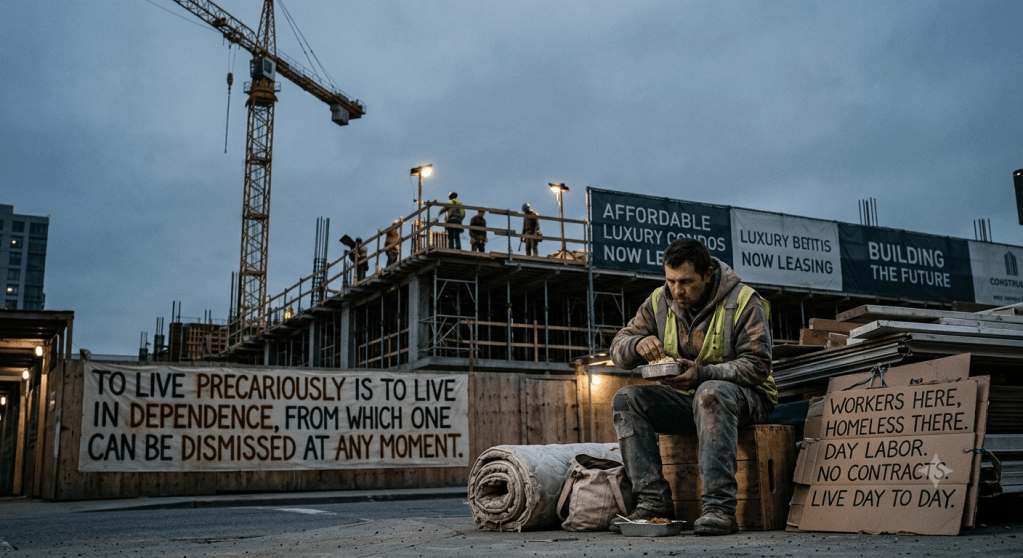
The word “precarious” derives from the Latin “precarius”, which described something held only by the favour of another, something obtained through entreaty or prayer, from “prex”, meaning prayer. To live precariously, in the oldest sense of the word, is therefore to live in dependence, to occupy a position from which one can be dismissed at any moment, and to lack any secure claim upon the conditions that sustain one’s life. This etymology is worth remembering because it captures the double meaning that the term carries in contemporary criticism. Precarity names, on the one hand, a socioeconomic condition, the insecurity produced by casual contracts, informal work, indebtedness, migration regimes and the withdrawal of welfare protections. It names, on the other hand, an existential and ethical condition, the exposure of every human life to injury, loss and the actions of others. The scholarship that has grown around these two meanings since the late 1990s, and especially since the global financial crisis of 2008, is now commonly called the literature of precarity. The phrase refers both to a body of theory associated with thinkers such as Pierre Bourdieu, Judith Butler, Guy Standing, Isabell Lorey, Lauren Berlant and Anna Tsing, and to a growing archive of imaginative writing, the novels, plays, poems and memoirs that give narrative and affective form to insecure life. This essay introduces the key theorists, sets out their central arguments and disagreements, and indicates how literary studies has taken up the concept, so that one can use precarity as a critical lens with precision rather than as a vague synonym for hardship.
The concept has a specific European genealogy in the sociology of labour. The French term “précarité” circulated in social research on poverty and unstable employment during the 1970s and 1980s, but it acquired its polemical force through Pierre Bourdieu. In a 1997 address delivered to striking and unemployed workers, later collected in Contre-feux (1998) and translated in Acts of Resistance (1998), Bourdieu argued that job insecurity had become a general condition of contemporary societies rather than a marginal misfortune. His central claim was political rather than merely descriptive. Precarity, he insisted, is not an accidental by-product of economic modernisation but a deliberate mode of domination. When workers can be dismissed easily, when contracts are short and renewal is uncertain, the fear of losing work disciplines not only the unemployed but also those who still have jobs. Insecurity therefore functions as a technique of power that produces docility and undermines collective resistance, since people who cannot count on tomorrow find it difficult to organise, to strike or even to imagine a different future. Bourdieu captured the logic of this regime in the coinage “flexploitation”, a blend of flexibility and exploitation, suggesting that the celebrated flexibility of neoliberal labour markets (neoliberalism refers to the policy regime of deregulation, privatisation and flexible labour that spread from the 1980s onwards) is experienced from below as permanent vulnerability. Perhaps his most suggestive point for literary scholars is temporal: precarity destroys the capacity to project oneself into the future, and with it the narrative coherence of a life. A condition that damages plot, so to speak, invites literary analysis.
Two sociological contemporaries provide useful background, although neither made precarity his central term. Ulrich Beck argued in Risk Society (1992, first published in German in 1986) that late modern societies increasingly distribute risks rather than goods, and that structural insecurities are experienced as individual failures, a process he called individualisation. Zygmunt Bauman, in Liquid Modernity (2000), described the melting of stable institutions, careers, neighbourhoods and long-term bonds into fluid, short-term arrangements, so that individuals must constantly remake themselves without solid ground beneath them. Both accounts anticipate a key theme of precarity studies, namely that insecurity in the present age is not confined to the poor but seeps upwards through the professional classes, and that its psychological signature is chronic anxiety. Students should treat Beck and Bauman as the sociological atmosphere within which the more precise theoretical vocabulary of precarity later crystallised.
The most influential philosophical account of that vocabulary belongs to Judith Butler. In Precarious Life (2004), written in the aftermath of the attacks of 11 September 2001 and the wars that followed, Butler asked why some deaths are publicly mourned while others pass unnoticed. Grief, she argued, reveals that human beings are constitutively dependent on one another; we are undone by the loss of others because our selves are formed in relation to them. Yet this shared vulnerability is unequally acknowledged. Public frames of representation, such as the obituary, decide which lives count as lives and which deaths count as losses, so that the deaths of some populations, for instance civilian casualties of Western wars, are rendered unmournable. Butler names this differential the problem of grievability, and it has proved extraordinarily productive for literary criticism, since literature is itself a frame that can either confer or withhold recognition. A novel that narrates the interior life of a refugee, a bonded labourer or a woman abducted during a civil war performs the work of making a life apprehensible as a life, and thereby contests the frames that exclude it.
Butler sharpened the conceptual architecture in Frames of War (2009), where she distinguishes between precariousness and precarity, a distinction that every student of the field must master. Precariousness (an ontological category, that is, a claim about the nature of being) is the generalised condition of all embodied life. Every body can be injured, every life depends on networks of care, food, shelter and social support, and no life can secure itself by itself. Precarity, by contrast, is a “politically induced condition” (Butler, 2009, p. 25) in which particular populations are differentially exposed to injury, poverty and death because social and economic networks of support fail them or are withheld from them. Precariousness is shared; precarity is distributed. The political implication is egalitarian: if vulnerability is universal, then the radically unequal allocation of protection is unjust, and politics should aim at a more equal distribution of the conditions of livable life. In Notes Toward a Performative Theory of Assembly (2015), Butler extended the argument to collective action, suggesting that when precarious bodies gather in public squares, their very appearance together enacts a claim to livability. For Butler, then, precarity is not only a condition to be lamented but a possible ground of alliance across differences of class, nationality, gender and religion, since the demand for a livable life can be voiced from many social locations at once.
If Butler supplies the ethical and ontological grammar of the field, Guy Standing supplies its most widely cited sociological figure, the precariat. In The Precariat: The New Dangerous Class (2011), Standing fuses “precarious” with “proletariat” to name an emerging global “class-in-the-making” composed of people who live through insecure labour: temporary and part-time workers, interns, agency staff, platform workers, migrants and educated young people cycling through short contracts. Standing argues that the precariat is defined by the absence of seven forms of labour-related security that the industrial working class had won during the twentieth century, including secure employment, protection against arbitrary dismissal, opportunities for skill development, stable income and collective representation. Members of the precariat lack an occupational identity or narrative; they perform much unpaid “work-for-labour”, such as searching, applying, retraining and waiting; and many are “denizens” rather than citizens, holders of partial rights, as migrants often are. The experiential result, Standing suggests, is a compound of anger, anomie (a sociological term for normlessness and disorientation), anxiety and alienation. He calls the precariat dangerous because, lacking the old solidarities, it can be recruited by authoritarian populism, though it might equally become the agent of a new progressive politics. In A Precariat Charter (2014) he outlined remedies, most famously an unconditional basic income, that would detach security from employment altogether.
Standing’s thesis has attracted important criticism, and the criticism is itself part of the required reading. Jan Breman, a scholar of Indian labour, argued in his essay ‘A Bogus Concept?’ (2013) that the idea of the precariat universalises a specifically Northern experience. In India and much of the Global South, informal, casual and unprotected work has long been the norm rather than a novel departure, a reality Breman had documented in Footloose Labour (1996), his study of circulating migrant workers in Gujarat. From this vantage, the drama of precarisation looks like the belated arrival, in Europe, of conditions that most of the world’s workers never escaped. Brett Neilson and Ned Rossiter make a related point in their article ‘Precarity as a Political Concept, or, Fordism as Exception’ (2008): viewed historically and globally, it is the security of the Fordist era (Fordism names the mid-twentieth-century regime of mass production, stable employment and welfare protection in Western economies) that is the exception, and precarity that is the norm of capitalist life. These interventions matter in South Asia in particular, because they warn against importing a nostalgic European narrative of lost security into contexts where caste, informality and colonial labour regimes have structured insecurity for centuries. The anthropologist Kathleen Millar, in ‘Toward a Critical Politics of Precarity’ (2017), offers a helpful map of the field’s three registers, precarity as a labour condition, as an ontological experience and as a rallying point for political mobilisation, and cautions against collapsing them into one.
Isabell Lorey’s State of Insecurity: Government of the Precarious (2015, first published in German in 2012) synthesises Butler and Michel Foucault into a theory of how insecurity is governed. Lorey distinguishes three dimensions. Precariousness is Butler’s shared existential vulnerability. Precarity is the hierarchical distribution of insecurity across categories such as class, gender, race and citizenship. Governmental precarisation, her most original contribution, names the process by which neoliberal states and markets govern subjects through insecurity itself (governmentality is Foucault’s term for the indirect guidance of people’s conduct). Where the classical welfare state promised protection in exchange for obedience, the neoliberal order normalises insecurity, making each person the entrepreneur and insurer of her own life. Lorey pays particular attention to cultural and creative workers, the freelancers, adjunct teachers and artists who choose flexible lives in the name of autonomy and thereby precarise themselves voluntarily, becoming the model subjects of the new regime. Yet she does not end in pessimism. Drawing on the European “EuroMayDay” movements of the early 2000s, she argues that the precarious, precisely because they cannot be represented by traditional unions or parties, may invent new forms of connection and refusal. For students of literary institutions, Lorey’s analysis of self-precarising creative labour illuminates the economic conditions of authorship itself, from the Grub Street hack to the adjunct lecturer writing fiction between marking loads.
Lauren Berlant approaches precarity through affect (the study of feelings, moods and bodily intensities as social phenomena) rather than through labour law or ontology. In Cruel Optimism (2011), Berlant defines the book’s title concept as the relation that arises “when something you desire is actually an obstacle to your flourishing” (Berlant, 2011, p. 1). The objects of such cruel attachment are the postwar fantasies of the good life, upward mobility, secure employment, durable intimacy and political belonging, fantasies that no longer correspond to material possibility yet continue to organise desire. People stay attached to these fraying promises because the attachment itself provides continuity, a sense of what it means to keep on living, even as it wears them out. Berlant argues that since the 1990s crisis has ceased to be an event and has become an environment, a condition she calls “crisis ordinariness”, in which emergencies are absorbed into the routines of getting by. Related is her account of “slow death”, the gradual wearing out of populations through overwork, poor food and unlivable schedules, an attrition too slow and diffuse to register as catastrophe. Berlant develops these ideas through readings of contemporary novels and films, including the Dardenne brothers’ film Rosetta (1999), about a Belgian teenager desperately seeking work, and thereby demonstrates a method that literary studies can emulate: attending to genre, tone and the impasse, her term for the stretched-out present in which protagonists tread water rather than progress, as formal registrations of precarious life.
Two further theorists extend the concept toward death and toward ecology. Giorgio Agamben’s Homo Sacer: Sovereign Power and Bare Life (1998) analyses the ancient Roman figure of the “homo sacer”, a person who could be killed with impunity but not sacrificed, in order to argue that sovereign power operates by producing “bare life”, life stripped of political standing and exposed to violence, with the camp as its modern paradigm. Achille Mbembe’s essay ‘Necropolitics’ (2003) pushes the analysis into colonial and postcolonial terrain, arguing that modern power is exercised not only by managing life (biopolitics, Foucault’s term for the government of populations through health, birth and productivity) but by dictating who may die and who must live in “death-worlds”, zones such as plantations, occupied territories and besieged townships whose inhabitants persist in conditions approaching those of the living dead. One should note both the affinity and the difference between these frameworks and Butler’s. Precarity theory shares with Agamben and Mbembe a concern with populations abandoned by law and welfare, but Butler and Lorey resist the suggestion that the precarious are reduced to bare life, insisting that they remain capable of speech, appearance and political action. Anna Lowenhaupt Tsing, finally, carries precarity beyond the human. In The Mushroom at the End of the World (2015), an ethnography of matsutake mushroom pickers and the global supply chains of a fungus that flourishes in ruined industrial forests, Tsing defines precarity simply as “life without the promise of stability” (Tsing, 2015, p. 2) and proposes that it is now the condition of the entire planet, of humans and nonhumans alike, in the ruins that capitalism leaves behind. Her work builds the bridge between precarity studies and the environmental humanities, suggesting that ecological damage and labour insecurity are entangled expressions of the same extractive order, and that survival now depends on unglamorous, collaborative arts of living amid disturbance.
Literary studies has absorbed these theories with remarkable speed, and a recognisable field of “precarity criticism” now exists. Liam Connell’s Precarious Labour and the Contemporary Novel (2017) examines how fiction represents zero-hours contracts, migrant work, service labour and the ideology of flexibility, arguing that the novel both records and resists the narratives through which insecure work is normalised. Sieglinde Lemke’s Inequality, Poverty and Precarity in Contemporary American Culture (2016) identifies a resurgent American writing of the poor, from memoir to fiction, that she reads as a new “precarity lit”. The essays gathered by Emily J. Hogg and Peter Simonsen in Precarity in Contemporary Literature and Culture (2021) demonstrate the range of the field, treating precarity not merely as a theme that texts depict but as a pressure that shapes literary form, feeling and genre. Precarity enters literature as broken or suspended narrative time, since characters who cannot plan cannot generate conventional plots; as the thwarted Bildungsroman (the novel of formation and development), in which education leads to internships rather than establishment; as present-tense, episodic and fragmentary narration that mimics life lived shift by shift; and as tonal registers of exhaustion, irony and low-level dread that correspond to Berlant’s impasse. Asking how a text organises time, how it distributes grievability among its characters, and what fantasies of the good life it exposes as cruel is often more illuminating than simply cataloguing scenes of poverty.
The archive available for such analysis stretches back well before the coining of the term. The Victorian industrial novel is an obvious prehistory: Charles Dickens’s Hard Times (1854) and Elizabeth Gaskell’s North and South (1855) dramatise the exposure of factory workers to injury, dismissal and famine wages, while Thomas Hardy’s Jude the Obscure (1895) traces the destruction of a rural artisan whose aspirations exceed his class position. Knut Hamsun’s Hunger (1890) gives modernist form to the delirium of a starving casual writer, and George Orwell’s Down and Out in Paris and London (1933) documents the choreography of destitution from the inside. John Steinbeck’s The Grapes of Wrath (1939) remains the canonical narrative of dispossessed migrant labour, and Samuel Beckett’s Waiting for Godot (1953), with its two tramps suspended in an empty present, can be read as the purest theatrical form of the impasse, precarity distilled into waiting. Contemporary fiction has made the condition explicit. John Lanchester’s Capital (2012) and Zadie Smith’s NW (2012) map post-crash London across lines of property, migration status and class; Mohsin Hamid’s How to Get Filthy Rich in Rising Asia (2013) parodies the self-help genre to expose the fragility of upward mobility in the Global South; Ling Ma’s Severance (2018) fuses the office novel with apocalypse to satirise routinised labour that continues even as the world ends. South Asian writing offers particularly rich material. Rohinton Mistry’s A Fine Balance (1995) follows tailors and students through the Emergency, showing how caste, eviction and state violence compound economic insecurity; Aravind Adiga’s The White Tiger (2008) narrates the murderous underside of servitude in liberalising India; and Katherine Boo’s work of narrative nonfiction Behind the Beautiful Forevers (2012) reconstructs life and death in a Mumbai slum with novelistic density. Read alongside Breman’s labour scholarship, such texts allow students to test, and where necessary provincialise, the European theory of precarity against subcontinental realities in which caste hierarchies allocate insecure and stigmatised work long before neoliberal flexibilisation (flexible liberalisation) arrived.
Three payoffs, in conclusion, justify the effort of studying this literature. The first is thematic: precarity theory equips readers to analyse how texts represent insecure work, housing, citizenship and care, and to connect those representations to identifiable regimes of accumulation and government rather than to timeless misfortune. The second is formal: the concepts of the impasse (a situation in which no progress is possible, typically because two opposing sides are deadlocked and refuse to compromise), crisis ordinariness, slow death and grievability translate directly into questions about narrative time, genre, tone and characterisation, and thereby renew formalist analysis with political content. The third is ethical and political: Butler’s insight that literature functions as a frame of grievability makes the study of fiction itself a way of asking whose lives are apprehended as lives, a question with obvious force for readers of Partition narratives, Dalit life writing, refugee memoirs and climate fiction alike. Researchers should nonetheless keep the field’s distinctions sharp. Precariousness is not precarity; the precariat is a contested sociological claim, not a settled fact; bare life is not the same as precarious life; and the Northern story of security lost after Fordism must not be mistaken for a universal history. Used with such care, precarity offers one of the most powerful vocabularies currently available for connecting literary form to the unequal distribution of security, suffering and hope in the contemporary world.
References
Agamben, G. (1998). Homo Sacer: Sovereign Power and Bare Life (D. Heller-Roazen, Trans.). Stanford University Press.
Bauman, Z. (2000). Liquid Modernity. Polity Press.
Beck, U. (1992). Risk Society: Towards a New Modernity (M. Ritter, Trans.). Sage Publications.
Berlant, L. (2011). Cruel Optimism. Duke University Press.
Boo, K. (2012). Behind the Beautiful Forevers: Life, Death and Hope in a Mumbai Undercity. Random House.
Bourdieu, P. (1998). Acts of Resistance: Against the Tyranny of the Market (R. Nice, Trans.). The New Press.
Breman, J. (1996). Footloose Labour: Working in India’s Informal Economy. Cambridge University Press.
Breman, J. (2013). ‘A Bogus Concept?’. New Left Review, 84, 130-138.
Butler, J. (2004). Precarious Life: The Powers of Mourning and Violence. Verso.
Butler, J. (2009). Frames of War: When Is Life Grievable?. Verso.
Butler, J. (2015). Notes Toward a Performative Theory of Assembly. Harvard University Press.
Connell, L. (2017). Precarious Labour and the Contemporary Novel. Palgrave Macmillan.
Hogg, E. J., & Simonsen, P. (Eds.). (2021). Precarity in Contemporary Literature and Culture. Bloomsbury Academic.
Lemke, S. (2016). Inequality, Poverty and Precarity in Contemporary American Culture. Palgrave Macmillan.
Lorey, I. (2015). State of Insecurity: Government of the Precarious (A. Derieg, Trans.). Verso.
Mbembe, A. (2003). ‘Necropolitics’. Public Culture, 15(1), 11-40.
Millar, K. M. (2017). ‘Toward a Critical Politics of Precarity’. Sociology Compass, 11(6), e12483.
Neilson, B., & Rossiter, N. (2008). ‘Precarity as a Political Concept, or, Fordism as Exception’. Theory, Culture & Society, 25(7-8), 51-72.
Standing, G. (2011). The Precariat: The New Dangerous Class. Bloomsbury Academic.
Standing, G. (2014). A Precariat Charter: From Denizens to Citizens. Bloomsbury Academic.
Tsing, A. L. (2015). The Mushroom at the End of the World: On the Possibility of Life in Capitalist Ruins. Princeton University Press.