
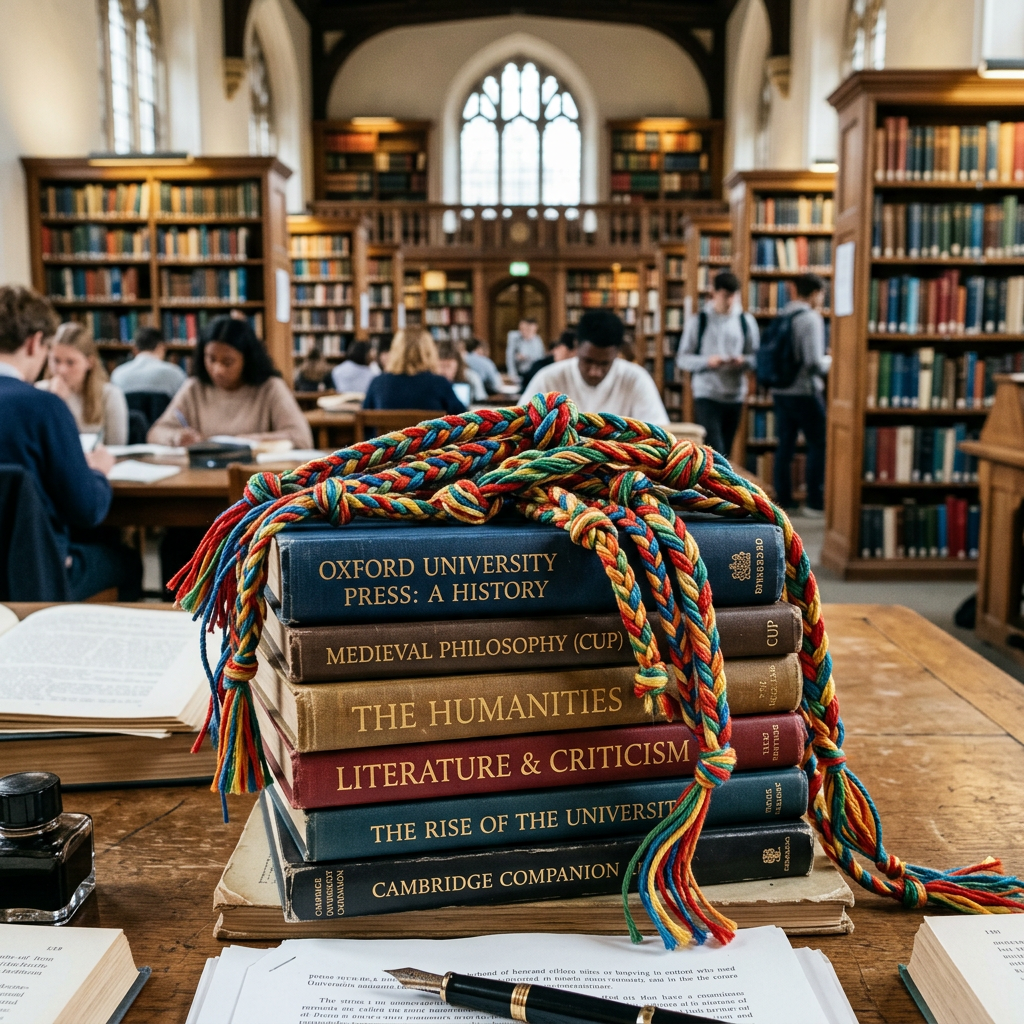
Literary theory is usually taught as if it were a natural sequence of ideas, a relay race in which formalism hands the baton to structuralism, structuralism to post-structuralism, and so on down to the present. This tidy picture conceals a far more interesting truth. Theory did not descend from the sky as a finished doctrine; it was made, slowly and often accidentally, by particular people in particular institutions, under political pressures that had little to do with the seminar room. Many of its founding figures never intended to become literary theorists at all, and several were astonished, sometimes embarrassed, by what literature departments did with their work. The making of theory is therefore three stories braided together: an intellectual story about ideas, a biographical story about accidental careers and surprised makers, and an institutional story about the modern university, its politics, its rewards, and its fierce resistances.
The first thing to understand is that “literary theory” as a named field was assembled retrospectively, largely in American universities, out of materials that were not originally literary at all. Gerald Graff, in Professing Literature: An Institutional History (1987), showed that the discipline of English has never possessed a stable identity; it has lurched from classical rhetoric to Germanic philology [the historical and comparative study of languages and old texts] to appreciative criticism to New Critical close reading, each new generation denouncing its predecessors as mechanical or impressionistic. Graff’s crucial insight is that the department absorbed each conflict through what he called the “field-coverage principle”, the administrative habit of simply adding a new specialist and a new course rather than debating the disagreement openly. When theory arrived in the 1960s and 1970s, it was processed in exactly the same way: the department hired a theorist, listed a theory course, and carried on. Theory was thus made into a field by the very institution it claimed to unsettle, a paradox to which this essay will return.
Even the supposedly theory-free criticism that theory later displaced was itself made by accident and improvisation. Cambridge English, the seedbed of modern close reading, was cobbled together after the First World War by men who were not literary scholars at all: I. A. Richards was trained in moral sciences [the Cambridge name for philosophy and psychology], and he stumbled upon his most influential discovery through a classroom experiment. Distributing unsigned poems to his students and collecting their written responses, he found the results so chaotic, so full of stock responses and irrelevant associations, that he published them as Practical Criticism (1929), a book that founded the pedagogy of close reading upon documented evidence of how badly even elite readers read. His student William Empson wrote Seven Types of Ambiguity (1930), one of the century’s most influential critical books, at the age of twenty-three, shortly after being expelled from his Cambridge fellowship when contraceptives were found in his rooms; the book that taught generations to read for multiple meanings was composed by a disgraced undergraduate mathematician turned poet. Francis Mulhern’s study The Moment of ‘Scrutiny’ (1979) showed how the Leavisite movement that grew from these beginnings understood itself not as an academic specialism but as a cultural mission conducted from the margins of an indifferent university. The lesson is worth underlining: long before structuralism, the discipline’s “traditional” methods were themselves recent, contingent and polemical makings, a point Eagleton (1983) presses when he notes how quickly the improvisations of the 1920s hardened into what later generations defended as timeless common sense.
If the making of theory has a founding scene, most historians locate it at a conference held at Johns Hopkins University in October 1966, called “The Languages of Criticism and the Sciences of Man”, whose proceedings were published by Richard Macksey and Eugenio Donato as The Structuralist Controversy (1970). The conference was designed to introduce French structuralism to America, with Roland Barthes, Jacques Lacan, Tzvetan Todorov, Lucien Goldmann and others in attendance. The accident was that a young and then little-known philosopher, Jacques Derrida, delivered a paper, ‘Structure, Sign and Play in the Discourse of the Human Sciences’, which dismantled structuralism at the very moment of its American arrival. Derrida argued that every structure has been thought as organised around a centre that limits its play, yet the centre is a contradictory notion, both inside and outside the structure it governs, so that, in his famous formulation, “the center is not the center” (Derrida, 1978, p. 279). American literature departments thus received structuralism and post-structuralism almost simultaneously, in a single package, and the compound came to be called simply “theory”. The making of theory, in other words, began with a lecture that undid the movement the conference was supposed to celebrate.
François Cusset, in French Theory: How Foucault, Derrida, Deleuze, & Co. Transformed the Intellectual Life of the United States (first published in French in 2003, English translation 2008), demonstrated that what Anglophone academia calls “French theory” is in an important sense an American invention. In France, Derrida, Michel Foucault, Gilles Deleuze and Jean-François Lyotard belonged to different disciplines, quarrelled with one another, and were read within specific philosophical and political contexts. In the United States they were translated, anthologised, taught side by side and fused into a single canon that no French reader would have recognised. Cusset (2008) showed that this creative misreading occurred chiefly in literature departments rather than in philosophy departments, which remained loyal to analytic philosophy [the Anglo-American tradition emphasising logic and conceptual clarity] and largely refused the French imports. The making of theory was therefore also a work of translation, publishing and curriculum design. Anthologies completed the process: when The Norton Anthology of Theory and Criticism appeared under the general editorship of Vincent B. Leitch (2001), theory acquired the ultimate mark of institutional arrival, a canon of its own stretching from Plato to the present, packaged for classroom use exactly like the canon of poetry it had once interrogated.
Edward Said gave this whole process its most useful concept in his essay ‘Traveling Theory’, collected in The World, the Text, and the Critic (1983). Said argued that ideas never move from one context to another unchanged; a theory born in revolutionary struggle can become, in a comfortable academic setting, a tame method, its original force domesticated by distance and institutionalisation. His example was Georg Lukacs’s theory of reification [the process by which human relations appear as relations between things], which began as an instrument of revolutionary consciousness in Budapest in 1919 and became, in the hands of later academic critics, a purely literary tool. The making of literary theory is largely a history of such travels: Saussure travelling from linguistics into anthropology and criticism, Gramsci travelling from an Italian prison into British cultural studies, Derrida travelling from the margins of French philosophy into the centre of American English departments. Each journey remade the theory, and, as Said insisted, the critic’s task is to measure what was gained and lost in transit.
The biographical story is even more striking, because an astonishing number of the founders of theory were accidental theorists, people whose canonical status was created posthumously, belatedly or by sheer contingency. Ferdinand de Saussure, whose ideas underlie the whole structuralist tradition, never wrote the book that made him famous. The Course in General Linguistics (first published in 1916) was reconstructed after his death by his colleagues Charles Bally and Albert Sechehaye from students’ lecture notes, so that the founding text of modern theory is, strictly speaking, a compilation Saussure neither wrote nor approved (Saussure, 1959). Antonio Gramsci composed his reflections on hegemony, intellectuals and culture in fascist prisons between 1929 and 1935, in fragmentary notebooks written under censorship; they were published only after the Second World War and reached English readers as Selections from the Prison Notebooks (1971), decades after his death in 1937. Walter Benjamin, whose essays are now compulsory reading in every theory course, died fleeing the Nazis in 1940 with much of his work unpublished; his fame in the English-speaking world dates from Hannah Arendt’s edition of Illuminations (1968). Mikhail Bakhtin, who developed his ideas of dialogism [the principle that every utterance answers and anticipates other utterances] and the carnivalesque in the Soviet Union of the 1920s and 1930s, was arrested, exiled and forgotten, and was rediscovered by Soviet graduate students only in the 1960s, reaching Western readers through translations such as The Dialogic Imagination (1981). In each case, the “theorist” was made by editors, translators and historical luck long after the thinking was done.
The living founders were scarcely less accidental. Roland Barthes, as his biographers and his own autobiographical Roland Barthes by Roland Barthes (first published in 1975) record, spent his young adulthood in tuberculosis sanatoria, never completed the doctorate that a conventional French academic career required, and drifted through jobs in Romania, Egypt and cultural journalism before finding an irregular perch at the École Pratique des Hautes Études; the man who taught a generation how to read codes entered the academy through its side door. Michel Foucault held a chair not in literature or even philosophy but in the “history of systems of thought”, a title he invented for himself at the Collège de France in 1970, and he repeatedly denied being a structuralist even as literature departments filed him under that label (Foucault, 1972). Jacques Derrida was a philosopher, formed on Husserl and Heidegger, who failed his entrance examination to the École Normale Supérieure at his first attempt and remained institutionally marginal in France for most of his career; his transformation into the presiding spirit of American literary criticism was the work of others, above all of the literature professors at Yale and Johns Hopkins who imported him.
The Parisian institutions that produced theory were themselves shaped by expulsion and exile. Jacques Lacan, whose rereading of Freud through Saussure supplied literary theory with its account of the split subject, was effectively cast out of the International Psychoanalytical Association in 1963 in a rupture he liked to call his “excommunication”; as Elisabeth Roudinesco recounts in her biography Jacques Lacan (1997), it was Louis Althusser who then invited him to transfer his seminar to the École Normale Supérieure, where his audience changed from clinicians to philosophers, students and future literary critics. The accident of an institutional expulsion thus delivered psychoanalysis to the humanities: had Lacan remained a respectable analyst lecturing to doctors, there might have been no Lacanian literary criticism at all. Althusser’s own case is the most sombre in the whole story. A devout Catholic turned Communist philosopher, a prisoner of war for five years, and a lifelong sufferer from severe mental illness, he produced the essays on ideology that transformed literary and film studies in intervals between hospitalisations, and in 1980 he killed his wife Hélène during a mental breakdown and was confined without trial, ending his life in psychiatric institutions; his memoir The Future Lasts a Long Time (1993) is the testament of a thinker who never ceased to be astonished, and horrified, by his own making. Theory’s serene conceptual architecture, these lives remind us, was built by damaged, displaced and often desperate people.
Gayatri Chakravorty Spivak’s story shows how a single accidental decision could make a theorist. As she has recounted in interviews collected in The Post-Colonial Critic (1990), she was a young assistant professor at the University of Iowa, trained in comparative literature under Paul de Man at Cornell, when she came across Derrida’s De la grammatologie in a bookseller’s catalogue, ordered it out of curiosity, and proposed a translation to a university press although she had no standing as a philosopher and had never met Derrida. Her English version, Of Grammatology (1976), carried a long translator’s preface that became, for thousands of readers, the standard introduction to deconstruction, and it made Spivak famous before she had published a monograph of her own. Edward Said’s making was equally unplanned. Trained at Princeton and Harvard as a conventional comparatist, he wrote his first book on Joseph Conrad and, by his own account in the essay ‘Between Worlds’ (collected in Reflections on Exile, 2000), it was the Arab-Israeli war of 1967 and the vilification of Arabs in American public culture that politicised him and set him on the path to Orientalism (1978). Kate Millett was a doctoral student at Columbia whose thesis, published as Sexual Politics (1970), unexpectedly became a bestseller and supplied academic feminism with its founding polemic; she was made a theorist by a social movement, not by a career plan.
The British case is especially instructive, because the founders of cultural studies were made outside the university proper. Raymond Williams and Richard Hoggart both spent their formative teaching years not in Oxford or Cambridge English faculties but in adult education, teaching evening classes to workers through the Workers’ Educational Association and university extramural departments. Williams insisted on this point late in his life in the lecture ‘The Future of Cultural Studies’, warning against encyclopaedia entries that dated the birth of cultural studies from books of the late 1950s: “Don’t believe a word of it”, he said, for the decisive shift began in adult education, where students refused to accept that literature could be discussed apart from their own lives and histories (Williams, 1989, p. 154). E. P. Thompson likewise wrote The Making of the English Working Class (1963) while teaching extramural classes in Yorkshire. Stuart Hall, a Rhodes scholar from Jamaica, abandoned his Oxford doctoral thesis on Henry James to edit the New Left Review and taught in a London secondary school and in adult classes before Hoggart invited him to Birmingham; as he recalled in the interview ‘The Formation of a Diasporic Intellectual’ (Chen, 1996), he entered cultural studies sideways, through politics and migration, not through an academic ladder. The theory that later filled university syllabi was thus, in Britain, first made in classrooms the university barely acknowledged.
If the emergence of the theorists was accidental, their makings were also, in a precise sense, surprised: the thinkers were startled by what was made of them. Derrida is the clearest case. He was a philosopher writing about Plato, Rousseau, Husserl and Hegel, yet in the United States his most devoted readers were professors of English and comparative literature. The so-called Yale School, Paul de Man, J. Hillis Miller, Geoffrey Hartman and Harold Bloom, whose joint volume with Derrida, Deconstruction and Criticism (1979), announced the alliance, converted deconstruction into a practice of literary reading, and graduate students across America learned to produce deconstructive interpretations almost as a technique. Derrida repeatedly protested that deconstruction was not a method that could be applied, and in ‘Letter to a Japanese Friend’ (1983) he went so far as to list all the things deconstruction is not, including an analysis, a critique and a method; yet the American machine of application rolled on regardless (Derrida, 1991). Cusset (2008) observes the deep irony that Derrida became an honorary literary critic in a country whose philosophy departments largely refused to read him, while in France he was never absorbed by literary studies at all. The theorist was made abroad, in a discipline not his own, in a shape he did not choose.
Foucault’s surprise took a different form. He objected throughout the 1960s to being called a structuralist, adding a sharp denial to the foreword of the English edition of The Order of Things (1970), yet the label stuck because the American package of “French theory” required him to fit alongside Barthes and Lacan. Barthes himself was remade by his readers more than once: the scientific semiologist [student of sign systems] of the early 1960s was canonised, after ‘The Death of the Author’ (first published in 1967), as the prophet of the free reader, and his late, tender, autobiographical writings such as Camera Lucida (first published in 1980) sat awkwardly beside the militant demystifier his American students expected. Stuart Hall, for his part, spent his last decades gently protesting the institutional success of cultural studies, especially its American expansion, worrying that a project born of political urgency had become a comfortable profession; his essay ‘Cultural Studies and Its Theoretical Legacies’ (1992) records his astonishment, and his unease, at watching a marginal Birmingham enterprise become a global discipline. The general lesson is the one Said (1983) drew: theories are completed by their receptions, and the maker is often the last to recognise the finished product.
The most recent of the great surprised makings belongs to Judith Butler. Gender Trouble (1990) was written, by Butler’s own account, as an intervention within academic feminist philosophy, a critique of the assumption that feminism requires a stable category of “woman”; its argument that gender is performative was addressed to a specialist debate. What happened next astonished its author. The book was taken up by activists, artists and an emerging field that came to be called queer theory [the study of sexuality and identity that questions fixed categories of gender and desire], and Butler became, within a decade, one of the most cited theorists alive. In the preface written for the book’s tenth anniversary edition, Butler confessed that “I did not know that the text would have as wide an audience as it has had”, nor that it would be received as a founding text of queer theory (Butler, 1999, p. vii). The confession is exemplary: like Derrida watching deconstruction become an American method, and like Hall watching cultural studies become a global profession, Butler discovered that a theorist does not make a theory’s meaning alone; readers, movements and institutions complete the making, often against or beyond the maker’s design.
These surprised makings lead directly to the politics of literary theory, because what made the 1960s reception so eager was not a sudden appetite for Saussurean linguistics but a political conjuncture. The generation that welcomed theory into the university was the generation of the Vietnam War protests, the civil rights movement, the women’s liberation movement, decolonisation and the events of May 1968 in Paris, when students and workers briefly shook the French state. Terry Eagleton, in Literary Theory: An Introduction (1983), argued that the rise of theory cannot be separated from this history: structuralism’s dream of scientific mastery and post-structuralism’s suspicion of all systems were, he suggested, contrasting responses to the hopes and defeats of 1968. Eagleton’s conclusion drew the moral bluntly, insisting that there is no such thing as a politically innocent criticism and that “departments of literature in higher education, then, are part of the ideological apparatus of the modern capitalist state” (Eagleton, 1983, p. 200). Whether or not one accepts the formulation, it captures what theory did to the discipline’s self-image: after theory, the claim that literary study stood above politics became itself a political claim.
Frank Lentricchia, in After the New Criticism (1980), told the American version of this story, showing how the New Criticism’s ideal of the autonomous poem, detached from history, suited the conservative climate of the Cold War university, and how the theory wave of the 1970s was, among other things, a revolt against that detachment. Feminist theory made the political genealogy explicit: Kate Millett’s Sexual Politics (1970) and the criticism that followed it came out of an activist movement and carried its energies into the classroom, insisting that the canon’s images of women were instruments of power. Postcolonial theory likewise carried the politics of decolonisation into literary study; Said wrote Orientalism (1978) as a Palestinian in America, and the book’s academic influence was inseparable from its political charge. The so-called canon wars of the 1980s and 1990s, in which curricula were fought over as if they were territories, confirmed that theory had made the syllabus a political object; Gerald Graff, in Beyond the Culture Wars (1992), proposed that universities should stop concealing these conflicts and instead “teach the conflicts” themselves, making the battle over books part of the education.
Yet the politics of theory was never simple or unidirectional, and some of its sharpest critics came from the left. Aijaz Ahmad, in In Theory: Classes, Nations, Literatures (1992), attacked the metropolitan theory industry from a Marxist position, arguing in his celebrated critique of Fredric Jameson’s essay ‘Third-World Literature in the Era of Multinational Capitalism’ (1986) that the very category of “third-world literature” homogenised vastly different societies, and that theory produced in Western universities could recolonise even as it spoke of liberation. Ahmad’s polemic mattered especially in India, where it forced a debate about whether importing theory was an act of intellectual emancipation or a new dependency. John Guillory, in Cultural Capital: The Problem of Literary Canon Formation (1993), added a sociological suspicion: drawing on Pierre Bourdieu, he argued that the canon debate mistook a crisis of the literary curriculum’s social function for a battle over representation, and that theory itself had become a form of “cultural capital” [Bourdieu’s term for the knowledge and credentials that confer status], the distinguishing possession of graduate students and professors rather than a weapon of the oppressed. The politics of theory, in Guillory’s account, was partly a politics of professional distinction.
This brings the story to the university itself, for literary theory is unimaginable outside the modern research university, its journals, presses, conferences and career ladders. The material infrastructure of theory was built with remarkable speed: the journal New Literary History was founded in 1969, Diacritics in 1971, Critical Inquiry in 1974, and these venues, together with university presses such as Johns Hopkins, Minnesota and Cornell, gave theory the apparatus of a normal science. Pierre Bourdieu, in Homo Academicus (first published in French in 1984), analysed the French academic field as a competitive space in which intellectual positions are also position-takings, moves in a struggle for authority; his analysis applies uncomfortably well to the theory boom, in which mastering the newest paradigm was also a strategy of advancement. David Shumway, in his essay ‘The Star System in Literary Studies’ (1997), described the emergence of the academic celebrity, the theorist as star whose name circulated like a brand, flown between conferences and bid for by wealthy departments; the star system, he argued, substituted personal charisma for the older authority of shared disciplinary standards.
Graff’s field-coverage principle explains how the university absorbed the shock. Instead of forcing a confrontation between, say, deconstruction and traditional literary history, departments simply appointed one of each and let students shuttle between incompatible worldviews from one classroom to the next (Graff, 1987). Theory thus became a field among fields, with its own survey courses, its own comprehensive examinations and, eventually, its own anthologies, a domestication that Bill Readings placed within a larger institutional transformation. In The University in Ruins (1996), Readings argued that the contemporary university no longer serves the nation-state’s culture, as the Humboldtian university did, but has become a transnational corporation administered under the empty banner of “excellence”; within such an institution, even radical theory functions smoothly, since the university of excellence does not care what is taught so long as it can be ranked and marketed. The university made theory possible, rewarded it, and in rewarding it, changed it: the discourse that had promised to expose institutions became one of the institution’s most successful products, a paradox that Hall, Guillory and Readings each registered from different directions.
The reception of theory in universities was therefore never a smooth conquest; it was a history of quarrels, scandals and organised resistance, and the resistance began in France before theory ever crossed the Atlantic. When Roland Barthes published On Racine (first published in 1963), reading the classical dramatist through psychoanalytic and structural categories, the Sorbonne scholar Raymond Picard replied with a furious pamphlet, Nouvelle Critique ou Nouvelle Imposture (1965) [New Criticism or New Fraud], accusing the “new criticism” of jargon, subjectivism and disrespect for scholarly method. Barthes answered with Criticism and Truth (first published in 1966), defending the plurality of interpretation and arguing that the old criticism’s “objectivity” was itself an ideology of taste. The Picard-Barthes quarrel, as Cusset (2008) notes, rehearsed in advance every later battle over theory: the charge of obscurity, the defence of interpretive freedom, the appeal to national tradition against foreign fashion.
In Britain, the decisive scandal was the Cambridge English Faculty’s “MacCabe affair” of 1981, when Colin MacCabe, a young lecturer associated with structuralist and post-structuralist approaches, was denied promotion after a bitter and very public faculty dispute; the case reached the national newspapers and made “structuralism” briefly a household word. Raymond Williams, who lived through the episode, analysed it in his lecture ‘Crisis in English Studies’ (delivered in 1981 and collected in Writing in Society, 1984), arguing that the quarrel was not really about one appointment but about the unresolved foundations of the discipline itself, which had never agreed on what literature is or why it should be studied. Williams’s diagnosis echoed Graff’s: the fury of the resistance measured the depth of questions the institution had long suppressed.
In the United States, resistance took both scholarly and polemical forms. M. H. Abrams, the great historian of Romanticism, debated J. Hillis Miller in the pages of Critical Inquiry, arguing in ‘The Deconstructive Angel’ (1977) that deconstructive reading was parasitic on the ordinary, determinate reading it claimed to undo, and that if texts could mean anything, the history of ideas became impossible; Miller replied in ‘The Critic as Host’ (1977) that the relation of parasite and host is itself undecidable, each living within the other, so that the “obvious” reading was already inhabited by what it excluded. E. D. Hirsch had earlier mounted the most rigorous defence of determinate meaning in Validity in Interpretation (1967), distinguishing a text’s unchanging “meaning”, fixed by authorial intention, from its changing “significance” for later readers. A younger generation then attacked theory from an unexpected angle: Steven Knapp and Walter Benn Michaels, in their essay ‘Against Theory’ (1982), argued that meaning simply is intended meaning, that no general theory can guide or constrain interpretation, and that the theoretical enterprise should therefore be abandoned, a provocation that generated years of replies in Critical Inquiry. And beyond the profession, Allan Bloom’s bestseller The Closing of the American Mind (1987) told an anxious public that relativist theory had corrupted the universities, turning the resistance to theory into a national culture war.
Paul de Man gave the resistance its most searching interpretation, and the circumstances were themselves an institutional parable. The Modern Language Association commissioned de Man to write a survey of literary theory for a volume on scholarship in the profession; the committee found his essay unacceptable and rejected it, and de Man published it separately as ‘The Resistance to Theory’ (1982), later the title essay of a posthumous book (1986). There he argued that resistance to theory is not an external accident but internal to theory itself, because theory reveals the unreliable, figurative nature of language, an insight that all reading, including theoretical reading, is tempted to evade; hence his paradoxical conclusion that “Nothing can overcome the resistance to theory since theory is itself this resistance” (de Man, 1986, p. 19). The profession’s rejection of an essay explaining the profession’s rejection of theory proved his point with almost comic precision. Yet de Man’s name soon carried a darker lesson about theory’s public standing: in 1987, the Belgian researcher Ortwin de Graef discovered that de Man had written for collaborationist, and in at least one case antisemitic, newspapers in occupied Belgium during the Second World War, and the revelation, examined in the volume Responses: On Paul de Man’s Wartime Journalism (Hamacher, Hertz and Keenan, 1989), was seized upon by theory’s enemies as evidence that deconstruction itself was evasive of moral truth. A decade later the physicist Alan Sokal completed the pattern of public scandal by publishing a deliberately nonsensical article, ‘Transgressing the Boundaries’ (1996), in the journal Social Text; when he revealed the hoax, and elaborated the attack with Jean Bricmont in Fashionable Nonsense (1998), the episode fixed in public memory the image of theory as fashionable obscurity, however unfairly it generalised from one unrefereed article.
Resistance eventually acquired its own institutional forms, mirroring the theory it opposed. In 2005, Daphne Patai and Will H. Corral edited Theory’s Empire: An Anthology of Dissent, a seven-hundred-page collection of essays critical of theory, explicitly designed as a counterweight to the Norton anthology; the resistance now had its own canon, its own university press and its own classroom apparatus. The volume gathered older sceptics such as René Wellek, who in his late essays had accused the new movements of destroying literary study from within, alongside philosophers, historians and disillusioned former theorists, and its very existence confirmed Graff’s (1987) analysis: the university metabolises every conflict by giving both sides a shelf. Meanwhile, a quieter form of resistance persisted in the daily life of departments, where, as surveys of the profession repeatedly suggested, many teachers continued to practise historical scholarship and close reading while leaving theory to the theorists, a peaceful coexistence that Graff regarded as the deepest defeat of all, since it allowed the fundamental questions theory had raised to go undiscussed once again.
The Indian university offers a final and instructive case of reception and resistance, because theory arrived there already entangled with the colonial history of English studies. Gauri Viswanathan’s Masks of Conquest (1989) had shown that English literature was institutionalised in India as a colonial instrument, and the theory debates of the late 1980s and 1990s were therefore also debates about decolonising the discipline. The collections Rethinking English edited by Svati Joshi (1991) and The Lie of the Land: English Literary Studies in India edited by Rajeswari Sunder Rajan (1992) gathered Indian scholars asking whether imported theory would finally allow a critique of the Arnoldian curriculum or merely replace one metropolitan authority with another. Harish Trivedi, in Colonial Transactions: English Literature and India (1993), voiced the sceptical position, warning that the rush to theory could become a new form of intellectual subordination in which Indian texts served only as raw material for Western concepts, while Ahmad (1992) pressed the Marxist version of the same worry. Yet the same decades showed theory being remade rather than merely received: Subaltern Studies turned post-structuralist reading upon the colonial archive, and feminist scholars such as Susie Tharu and K. Lalita, in the two volumes of Women Writing in India (1991 and 1993), used theoretical questions about canon and voice to recover a vast counter-archive of women’s writing in Indian languages. Reception, here (in India) as everywhere, was active: the periphery did not simply consume theory but tested, resisted and transformed it.
Looking back over these braided stories, the making of literary theory appears neither as a triumphal march of ideas nor as a mere academic fashion, but as a contingent historical formation in which accident, politics and institutions were as important as arguments. Its founding texts were compiled by students, smuggled out of prisons, recovered from exile and translated by unknown young scholars; its founders were sanatorium patients, adult education tutors, migrant intellectuals and philosophers embraced by the wrong department; its triumph was organised by journals, presses, anthologies and a star system that rewarded the very radicalism it domesticated; and its progress was contested at every step, from Picard’s pamphlet to the Cambridge affair, from Abrams’s protest to Sokal’s hoax, resistances that, as de Man saw, belong to theory’s own structure rather than standing outside it. Perhaps the deepest lesson is Said’s: theories travel, and are made and remade at every destination. The student in an Indian classroom who reads Derrida beside Ambedkar, or Foucault beside Phule, is not receiving a finished doctrine from elsewhere but participating in the next stage of the making, and the history recounted here suggests that the most important chapters of theory have always been written by those whom the institution least expected to write them.
References
Abrams, M. H. (1977). ‘The Deconstructive Angel’. Critical Inquiry, 3(3), 425-438.
Ahmad, A. (1992). In Theory: Classes, Nations, Literatures. Verso.
Althusser, L. (1993). The Future Lasts a Long Time (R. Veasey, Trans.). Chatto and Windus.
Arendt, H. (Ed.). (1968). Illuminations: Essays and Reflections (H. Zohn, Trans.). Harcourt, Brace and World.
Bakhtin, M. M. (1981). The Dialogic Imagination: Four Essays (M. Holquist, Ed.; C. Emerson & M. Holquist, Trans.). University of Texas Press.
Barthes, R. (1964). On Racine (R. Howard, Trans.). Hill and Wang.
Barthes, R. (1987). Criticism and Truth (K. P. Keuneman, Trans.). Athlone Press.
Bloom, A. (1987). The Closing of the American Mind. Simon and Schuster.
Bloom, H., de Man, P., Derrida, J., Hartman, G., & Miller, J. H. (1979). Deconstruction and Criticism. Seabury Press.
Bourdieu, P. (1988). Homo Academicus (P. Collier, Trans.). Polity Press.
Butler, J. (1990). Gender Trouble: Feminism and the Subversion of Identity. Routledge.
Butler, J. (1999). ‘Preface (1999)’. In Gender Trouble: Feminism and the Subversion of Identity (10th Anniversary ed., pp. vii-xxvi). Routledge.
Chen, K.-H. (1996). ‘The Formation of a Diasporic Intellectual: An Interview with Stuart Hall’. In D. Morley & K.-H. Chen (Eds.), Stuart Hall: Critical Dialogues in Cultural Studies (pp. 484-503). Routledge.
Cusset, F. (2008). French Theory: How Foucault, Derrida, Deleuze, & Co. Transformed the Intellectual Life of the United States (J. Fort, Trans.). University of Minnesota Press.
de Man, P. (1986). The Resistance to Theory. University of Minnesota Press.
Derrida, J. (1976). Of Grammatology (G. C. Spivak, Trans.). Johns Hopkins University Press.
Derrida, J. (1978). Writing and Difference (A. Bass, Trans.). University of Chicago Press.
Derrida, J. (1991). ‘Letter to a Japanese Friend’. In P. Kamuf (Ed.), A Derrida Reader: Between the Blinds (pp. 270-276). Columbia University Press.
Eagleton, T. (1983). Literary Theory: An Introduction. Blackwell.
Eagleton, T. (1984). The Function of Criticism: From The Spectator to Post-Structuralism. Verso.
Empson, W. (1930). Seven Types of Ambiguity. Chatto and Windus.
Foucault, M. (1970). The Order of Things: An Archaeology of the Human Sciences. Tavistock.
Foucault, M. (1972). The Archaeology of Knowledge (A. M. Sheridan Smith, Trans.). Tavistock.
Graff, G. (1987). Professing Literature: An Institutional History. University of Chicago Press.
Graff, G. (1992). Beyond the Culture Wars: How Teaching the Conflicts Can Revitalize American Education. W. W. Norton.
Gramsci, A. (1971). Selections from the Prison Notebooks (Q. Hoare & G. Nowell Smith, Eds. & Trans.). Lawrence and Wishart.
Guillory, J. (1993). Cultural Capital: The Problem of Literary Canon Formation. University of Chicago Press.
Hall, S. (1992). ‘Cultural Studies and Its Theoretical Legacies’. In L. Grossberg, C. Nelson, & P. A. Treichler (Eds.), Cultural Studies (pp. 277-294). Routledge.
Hamacher, W., Hertz, N., & Keenan, T. (Eds.). (1989). Responses: On Paul de Man’s Wartime Journalism. University of Nebraska Press.
Hirsch, E. D. (1967). Validity in Interpretation. Yale University Press.
Jameson, F. (1986). ‘Third-World Literature in the Era of Multinational Capitalism’. Social Text, 15, 65-88.
Joshi, S. (Ed.). (1991). Rethinking English: Essays in Literature, Language, History. Trianka.
Knapp, S., & Michaels, W. B. (1982). ‘Against Theory’. Critical Inquiry, 8(4), 723-742.
Leitch, V. B. (Ed.). (2001). The Norton Anthology of Theory and Criticism. W. W. Norton.
Lentricchia, F. (1980). After the New Criticism. University of Chicago Press.
Macksey, R., & Donato, E. (Eds.). (1970). The Structuralist Controversy: The Languages of Criticism and the Sciences of Man. Johns Hopkins University Press.
Miller, J. H. (1977). ‘The Critic as Host’. Critical Inquiry, 3(3), 439-447.
Millett, K. (1970). Sexual Politics. Doubleday.
Mulhern, F. (1979). The Moment of ‘Scrutiny’. New Left Books.
Patai, D., & Corral, W. H. (Eds.). (2005). Theory’s Empire: An Anthology of Dissent. Columbia University Press.
Picard, R. (1965). Nouvelle Critique ou Nouvelle Imposture. Jean-Jacques Pauvert.
Readings, B. (1996). The University in Ruins. Harvard University Press.
Richards, I. A. (1929). Practical Criticism: A Study of Literary Judgment. Kegan Paul.
Roudinesco, E. (1997). Jacques Lacan (B. Bray, Trans.). Columbia University Press.
Said, E. W. (1978). Orientalism. Pantheon Books.
Said, E. W. (1983). The World, the Text, and the Critic. Harvard University Press.
Said, E. W. (2000). Reflections on Exile and Other Essays. Harvard University Press.
Saussure, F. de. (1959). Course in General Linguistics (C. Bally & A. Sechehaye, Eds.; W. Baskin, Trans.). Philosophical Library.
Shumway, D. R. (1997). ‘The Star System in Literary Studies’. PMLA, 112(1), 85-100.
Sokal, A. (1996). ‘Transgressing the Boundaries: Toward a Transformative Hermeneutics of Quantum Gravity’. Social Text, 46/47, 217-252.
Sokal, A., & Bricmont, J. (1998). Fashionable Nonsense: Postmodern Intellectuals’ Abuse of Science. Picador.
Spivak, G. C. (1976). ‘Translator’s Preface’. In J. Derrida, Of Grammatology (pp. ix-lxxxvii). Johns Hopkins University Press.
Spivak, G. C. (1990). The Post-Colonial Critic: Interviews, Strategies, Dialogues (S. Harasym, Ed.). Routledge.
Sunder Rajan, R. (Ed.). (1992). The Lie of the Land: English Literary Studies in India. Oxford University Press.
Tharu, S., & Lalita, K. (Eds.). (1991-1993). Women Writing in India: 600 B.C. to the Present (2 Vols.). The Feminist Press.
Thompson, E. P. (1963). The Making of the English Working Class. Victor Gollancz.
Trivedi, H. (1993). Colonial Transactions: English Literature and India. Papyrus.
Viswanathan, G. (1989). Masks of Conquest: Literary Study and British Rule in India. Columbia University Press.
Williams, R. (1984). Writing in Society. Verso.
Williams, R. (1989). The Politics of Modernism: Against the New Conformists (T. Pinkney, Ed.). Verso.


 Literary Latitude