by Riya Bhatia
Armed with the powerful tool of imagination, Vandana Singh, widely regarded as the first speculative fiction writer, advocates against the “pathologically solipsist” dominant paradigms such as anthropocentrism, violence of patriarchy, colonialism, and (ir)rationalities of modernism to foreground the “transgressive potential” of speculative fiction at the grand stage of the universe (200-01). In The Woman Who Thought She Was a Planet and Other Stories, published in 2008, her characters inhabit meta-narratives rooted in tradition, her study of physics, and the environment.
In ‘Three Tales from Sky River: Myths for a Starfaring Age,’ the seemingly small tipi-bird becomes the sole bearer of cosmic warning, protecting the Saras People of Planet Jehana. In the ‘Myth of the Sonahli People,’ Haiho emerges as a guardian figure whose vigilance against the Medusa creature preserves his community from ecological and existential collapse; his double-bladed, serrated knife becomes a cultural inheritance, reminding the archipelago that mythic memory survives through embodied practices, technologies, and intergenerational caution. Furthermore, in the ‘Myth of the Angudka Tribe,’ the restoration of Angud’s whistle signals that myths are not just static allegories but they transcend the rigid boundaries of time, gain a life of their own, and always find a way to come back and serve a didactic purpose for generations.
In ‘Thirst,’ the festival of Naag-Panchami, with its invocation of serpent divinities, becomes for Susheela “the one day she had always understood to be her own” (95). Her experience of the stories of cobra gods, snake spirits who speak to gods and mingle secretly with humans, and underwater palaces where serpents guard “knowledge and wisdom they had accumulated” blurs the real and illusionary, human and non-human, and the past and present (96). It awakens her to her true sense of self, as “she walked into the house as if for the first time” (109).
Inevitably, these myths intertwine with natural elements: rivers, mountains, trees, stones, rain, animals, and celestial bodies. In The Great Derangement: Climate Change and the Unthinkable (2016), Amitav Ghosh said, “The climate crisis is also a crisis of culture and thus of the imagination” (13). Singh’s works can then be located in the theoretical framework of Marxist environmentalism. Just like capitalists treat the proletariat as a commodity, resulting in their exploitation, humans also treat nature as a commodity due to imperialism, industrialization, and ruthless urbanization, marking our departure from the physical universe, our origin. This worldview is fundamentally one of anthropocentrism, a concept challenged by the philosophy of deep ecology, which rejects the notion that humanity is the centre of value and instead advocates for the intrinsic worth of all non-human life. In ‘Delhi,’ the “Immaculate City” (38), for instance, Aseem “wonders whether complexity and vastness are sufficient conditions for a slow awakening, a coming to consciousness” (42).
In the titular story, ‘The Woman Who Thought She Was a Planet,’ Kamala’s assertion, “I know at last what I am. I am a planet” (44); in ‘The Wife,’ Padma’s act of “letting the wood take root inside her” (168) and setting the butterfly free; and in ‘The Tetrahedron,’ Maya’s ultimate act of stepping into the Tetrahedron and joining the voyagers, are metamorphoses that threaten the established hierarchy of the society. With their departure from the habitats of civilization, Kamala, Padma, and Maya claim selfhood and deny victimhood. They defer to be subsumed under any kind of domestic virtue and refuse to hide behind their husbands. In fact, the title, ‘The Wife,’ shows the universality of this condition. Yeong-hye’s refusal to eat meat in Han Kang’s The Vegetarian (2007) echoes an ecofeminist insight, as Val Plumwood would argue that the violence enacted on women’s bodies mirrors the violence inflicted on ecosystems under capitalist and patriarchal modernity.
Maya in ‘The Tetrahedron,’ a deeply existentialist story, is an embodiment of creativity and imagination who is trapped in a traditional, predictable marriage with Samir, a Ph.D. student in astrophysics who relies heavily on science and logic. Maya’s response to the tetrahedron is dismissed as “that time of the month…she doesn’t mean it…” by her mother as against Samir’s meticulously rational vocabulary of Möbius strips, dimensional anomalies, and cosmic timelines (149). This mirrors the themes of Charlotte Perkins Gilman’s The Yellow Wallpaper (1892), where patriarchal structures silence women’s creative and intellectual lives and treat them as inferior beings and relegate them to the position of the Other, in the sense articulated by Edward Said in Orientalism (1978). This phenomenon of internalized aesthetic racism, which compels marginalized individuals to desire the features of the dominant power, is the central tragedy of Toni Morrison’s The Bluest Eye (1994), where the protagonist Pecola Breedlove longs for the ultimate symbol of white beauty: blue eyes. Undoubtedly, Singh’s efforts constitute a “revolutionary potential” in contemporary women’s speculative fiction (200).
Thus, characters who feel out of place take refuge in nature. Water swirls up the body of Susheela, yet she doesn’t drown in it; it gives her renewed energy and life. In ‘Hunger’ too, the sheer effort of maintaining the social facade required by Vikas, her husband’s, corporate promotion makes Divya believe she is an alien who must “almost – learn the world anew” (9) every day, finding solace only in the fantasy that her apartment has been “travelling through alien universes all night” (8), and she escapes this anxiety of social climbing by retreating into an imagined identity, believing she is “from another planet, where you danced with trees” (10).
For Vandana Singh, one of the most exciting things about science is that it reveals the subtext of the physical world. In other words, surface reality isn’t all that there is; the world is full of hidden stories, connections, patterns, and the scientific as well as the literary and the psychological aspects of this multi-textured reality, which she finds fascinating.
This sensibility becomes explicit in ‘Infinities,’ where ancient philosophical puzzles and modern mathematical collapse into one another. Zeno’s paradox, resurfacing in the description of Abdul Karim’s mother “growing older and older… determined to live Zeno’s paradox,” transforms an abstract limit into a lived bodily experience (74). The mathematical structure of the cosmos, prime numbers, transcendental numbers, and the architecture of the “metacosmos” are not merely decorative; they become the grammar of reality itself (82). Abdul Karim’s revelation that prime numbers are “doorways to other universes” dramatizes Singh’s belief that science uncovers hidden stories embedded in the world’s fabric (82). His revelation compels him, just as epiphanies compel James Joyce’s Stephen Dedalus in A Portrait of the Artist as a Young Man (1916), to reject the ordinary world. Abdul Karim is seized by a nameless ecstasy and a frantic desire to “shouting through the city” the magnificence of the cosmos, dismissing the conflicts around him as the “sordid pettiness of everyday life, the struggles and quarrels of mean humanity” (83).
‘Conservation Laws’ dramatizes this principle further: Sahai-ji’s climactic act of crawling onto the spinning wheel to restore the conservation law becomes a narrative embodiment of Singh’s claim that behind apparent reality lies an intricate and fragile subtext. Even the extraterritorial geography of Vallis Marineris reinforces this worldview. The canyon is described as a literal “crack” across Mars, a site where hidden dimensions briefly surface, exposing the instability and permeability of cosmic boundaries (117).
This collapse between scientific model and lived experience resonates with Jean Baudrillard’s idea of simulacra, where representations no longer reflect reality but precede and generate it. In Singh’s universe, prime numbers, cosmic symmetries, and dimensional anomalies become hyperreal structures: models so powerful that they constitute the very fabric of the cosmos. The scientific subtext Singh describes thus aligns with Baudrillard’s hyperreality, in which the hidden architecture beneath the world is not material but mathematical, symbolic, and endlessly self-producing.
Her speculative landscapes are built on the assumption that the universe contains invisible layers: mathematical, physical, and metaphysical. The infinite and the finite, the abstract and the embodied, and order and chaos all coexist in a dynamic tension. Vandana Singh’s ultimate message to human beings is embodied in the Tipi-Bird’s fragmented cry, “Listen!” – a call to recognize the world’s deep interconnectedness, heed the complex, symbolic, and often scientific warnings embedded in the world’s fabric, or suffer the existential consequences of its self-imposed imaginative and intellectual silence (131).
Works Cited
Ghosh, Amitav. The Great Derangement: Climate Change and the Unthinkable. Penguin UK, 2018.
İleri, Sinem Çapar. “The Process of a Woman’s Freedom in Vandana Singh’s Contemporary Speculative Fiction: The Woman Who Thought She Was a Planet.” The Novel in Transition: Space, Identity, and the Politics of Transformation(2025): 71.
Joyce, James. A Portrait of the Artist as a Young Man. B. W. Huebsch, 1916.
Morrison, Toni. The Bluest Eye. Holt, Rinehart and Winston, 1970.
Said, Edward W. Orientalism. Pantheon Books, 1978.
Singh, Vandana. “A Sci-Fi Story of Earth’s Renewal.” YouTube, uploaded by TED, 11 July 2022, https://youtu.be/WlItCBR45nY.
Singh, Vandana. The Woman Who Thought She Was a Planet: And Other Stories. Penguin Books India, 2008.
About the Author
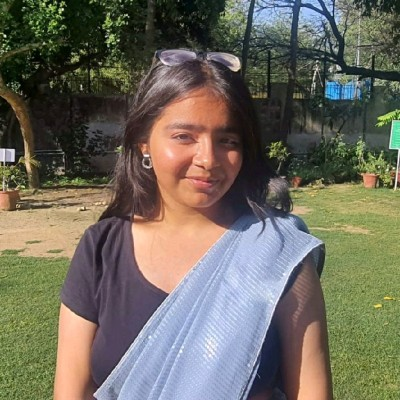
Riya Bhatia is a final-year B.A. (Hons.) English student at Gargi College, University of Delhi, and an incoming student in the Contemporary Literature, Culture and Theory MA programme at King’s College London. She is a recipient of the Gyan Khosla Memorial Award for academic excellence and her research won the Best Paper Award at a National Young Scholars’ Conference. Her research interests lie at the intersection of medical humanities, feminist theory, and popular culture, with a particular focus on representations of illness, gender, and narrative in contemporary media. Alongside her academic work, she has contributed to content and communication projects with organisations such as UN Women and WhatsApp Business, where she has worked on writing and storytelling initiatives. She has also worked as a teaching volunteer, developing curriculum and facilitating personality development programmes for school students. Her broader interests include pedagogy, social impact, and public-facing scholarship. She can be assessed through her (Riya Bhatia | LinkedIn) profile.