
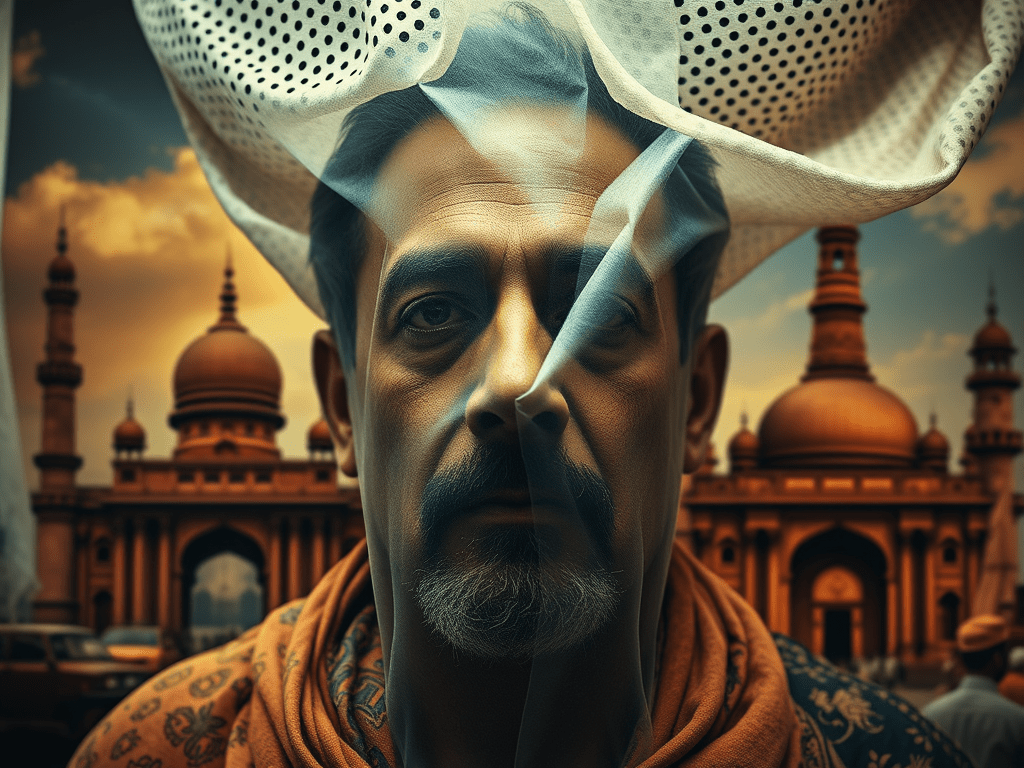
Salman Rushdie stands as a pivotal figure in contemporary literature, renowned for his intricate narratives that seamlessly blend magical realism with the historical and political landscapes of the Indian subcontinent . His distinctive narrative approach often incorporates a rich tapestry of languages, reflecting the multilingual reality of India, and frequently adopts a self-conscious style that challenges conventional understandings of history and fiction . Midnight’s Children, published in 1981 as his second novel, is a seminal work in postcolonial literature, garnering widespread critical acclaim, including the prestigious Booker Prize and the “Booker of Bookers” award . The novel’s central conceit lies in the allegorical connection between its protagonist, Saleem Sinai, born at the precise moment of India’s independence, and the unfolding history of the newly formed nation . This note aims to provide a comprehensive analysis of Midnight’s Children, encompassing a detailed plot summary, an examination of its key characters, discussions of its major themes and symbols, and an exploration of its rich cultural, historical, and political context within the era of post-independence India.
Detailed Plot Summary
The narrative of Midnight’s Children unfolds through the voice of Saleem Sinai, who, nearing his thirty-first birthday, feels his body beginning to crack and crumble . Facing imminent death, Saleem urgently undertakes the task of narrating his life story, a narrative he believes is inextricably linked with the destiny of India .
Book One: The Perforated Sheet
Saleem’s story commences with the history of his maternal grandfather, Dr. Aadam Aziz, in Kashmir in 1915 . After losing his faith upon striking his nose against the ground during prayer, Aadam develops a profound sense of emptiness . His subsequent courtship of Naseem Ghani, conducted through a perforated sheet due to the strict social customs of the time, marks the beginning of Saleem’s family lineage . This unusual courtship, where Aadam falls in love with Naseem piece by piece as he examines her ailments through the hole, symbolizes the cultural and sexual separation prevalent in Indian society and hints at the fragmented nature of perception and relationships within the novel . Aadam and Naseem marry and relocate to Agra, where Aadam witnesses the brutal suppression of protests for Indian independence, a foreshadowing of the political strife that will continue to shape the nation . They have five children: Alia, Mumtaz, Emerald, Mustapha, and Hanif . Mumtaz enters into a secret marriage with Nadir Khan, the assistant of the nationalist leader Mian Abdullah, but the marriage remains unconsummated due to Nadir’s impotence . Following the discovery of this secret, the marriage is annulled, and Mumtaz later marries Ahmed Sinai, a merchant who renames her Amina . Amina and Ahmed eventually move to Bombay, purchasing a mansion on Methwold’s Estate from William Methwold, a British colonist preparing to leave India after independence . This estate, once a symbol of British colonial power, now becomes the backdrop for the birth that will intertwine personal and national histories .
Book Two: The Fisherman’s Pointing Finger
As India approaches independence, Amina becomes pregnant, coinciding with the pregnancy of Vanita, the wife of a poor entertainer named Wee Willie Winky . Unbeknownst to Willie Winky, Vanita is carrying the child of William Methwold, highlighting the complex social and personal dynamics on the eve of independence . At the stroke of midnight on August 15, 1947, the precise moment of India’s independence, both Amina and Vanita give birth to sons: Saleem Sinai and Shiva, respectively . In the nursing home, a midwife named Mary Pereira, driven by her socialist ideals and a desire to strike a blow against social inequality, switches the nametags of the two infants . This act, born from a sense of social justice, inadvertently swaps the destinies of the wealthy Saleem (biologically Vanita’s son) and the poor Shiva (biologically Amina’s son) . Saleem grows up in Bombay, bearing a distinctive large nose and blue eyes, and at the age of ten, he discovers his telepathic ability, which connects him to 1001 other children born within the first hour of India’s independence – the “midnight’s children” . He forms the Midnight Children’s Conference (MCC), a telepathic gathering that mirrors the linguistic, cultural, and religious diversity of India, yet also reflects the challenges of achieving unity within this diversity . An accident reveals that Saleem’s blood type does not match his parents, leading Mary Pereira to confess her act of switching the babies . The Sinai family later moves to Pakistan to live with Amina’s sister, Emerald, and her husband, General Zulfikar, where Saleem witnesses the political unrest in the newly formed nation . After Ahmed Sinai’s death, Saleem returns to Bombay and undergoes surgery on his nose, losing his telepathic abilities but gaining an extraordinary sense of smell that allows him to perceive emotions . The family then returns to Pakistan. Saleem’s younger sister, Jamila, becomes a renowned singer known as Jamila Singer . During the Indo-Pakistani War of 1965, Saleem’s entire family, except for Jamila, perishes in an air raid. Saleem is struck on the head by his grandfather’s silver spittoon, resulting in complete amnesia .
Book Three: The Buddha
Suffering from amnesia, Saleem is conscripted into the Pakistani army due to his enhanced sense of smell, which is mistaken for tracking ability . He witnesses the horrific atrocities of the Bangladesh Liberation War of 1971 and eventually flees into the Sundarbans jungle with other soldiers . In the jungle, Saleem gradually recovers his memory but not his name . He encounters Parvati-the-witch, another midnight’s child, who restores his name and helps him return to India . They find refuge in the magician’s ghetto in Bombay, living with Picture Singh, a snake charmer . Parvati has an affair with Shiva and becomes pregnant . During this time, Prime Minister Indira Gandhi declares a state of emergency, and her government initiates a sterilization campaign . The magician’s ghetto is destroyed, Parvati is killed, and Saleem is captured by Shiva and taken to a sterilization camp . Under duress, Saleem reveals the identities of the remaining midnight’s children, who are subsequently rounded up and sterilized, effectively ending their unique powers . Following the end of the Emergency and Indira Gandhi’s electoral defeat, the midnight’s children are released . Saleem seeks out Parvati’s son, Aadam, whom he finds living with Picture Singh . They travel to Bombay, where Saleem encounters Mary Pereira, now the owner of a pickle factory, and meets Padma, who works there . Saleem finishes recounting his life story to Padma and plans to marry her on his thirty-first birthday, which coincides with the anniversary of India’s independence. He foresees his own death on this day, predicting that he will disintegrate into six hundred million pieces of dust, mirroring the population of India .
Character Analysis
Midnight’s Children features a vast array of characters, each contributing to the intricate tapestry of the narrative.
Main Characters:
- Saleem Sinai: The narrator and protagonist, born at the stroke of midnight on August 15, 1947. He possesses telepathic abilities in his youth and later develops an extraordinary sense of smell. Saleem’s life is presented as an allegory for the history of independent India .
- Shiva: Born at the same moment as Saleem, he is the other baby switched by Mary Pereira. Raised in poverty, he becomes a powerful and ruthless war hero, serving as Saleem’s antagonist and alter ego .
- Parvati-the-witch (Laylah): A midnight’s child with the power of illusion. She becomes Saleem’s wife and is the mother of his son, Aadam (biologically Shiva’s child) .
- Padma: Saleem’s devoted companion and future wife, who serves as the primary audience for his story. She works at Mary Pereira’s chutney factory .
- Amina Sinai (formerly Mumtaz Aziz): Saleem’s adoptive mother, a strong-willed and superstitious woman who initially marries Nadir Khan before marrying Ahmed Sinai .
- Ahmed Sinai: Saleem’s adoptive father, a businessman who later struggles with alcoholism .
- Mary Pereira: The nurse who switches Saleem and Shiva at birth. She later becomes Saleem’s ayah and eventually owns a chutney factory .
- Aadam Aziz: Saleem’s grandfather, a doctor who loses his faith and whose courtship of Naseem through a perforated sheet begins the family saga .
- Naseem Aziz (Reverend Mother): Saleem’s grandmother, a devout woman who marries Aadam Aziz .
- Jamila Singer (formerly the Brass Monkey): Saleem’s younger sister, who becomes a famous singer in Pakistan .
Minor Characters:
Significant minor characters include Nadir Khan, Mian Abdullah, William Methwold, Wee Willie Winky, Picture Singh, Indira Gandhi (“The Widow”), and Aadam Sinai (Parvati and Shiva’s son) . These characters, while not central to the narrative in the same way as Saleem and Shiva, play crucial roles in shaping Saleem’s life and illustrating the broader social and political context of the novel.
Key Characters and Their Significance:
| Character Name | Role in the Plot | Key Relationships | Primary Symbolic Significance |
| Saleem Sinai | Narrator, protagonist, born at India’s independence | Son of Amina and Ahmed (adoptive), biologically son of Vanita and William Methwold, husband of Parvati (briefly), fiancé of Padma, arch-rival of Shiva | Allegory of India, embodies its diversity and history |
| Shiva | Antagonist, born at India’s independence, switched with Saleem | Son of Vanita and Wee Willie Winky (adoptive), biologically son of Amina and Ahmed, father of Aadam Sinai (with Parvati), rival of Saleem | Represents the destructive and powerful aspects of India |
| Parvati-the-witch (Laylah) | Midnight’s child, Saleem’s wife | Wife of Saleem, lover of Shiva, mother of Aadam Sinai | Embodies the magical and mystical aspects of India |
| Padma | Saleem’s companion and listener | Fiancée of Saleem, works at Mary Pereira’s chutney factory | Represents the grounded, skeptical audience and the common person in India |
| Amina Sinai | Saleem’s adoptive mother | Wife of Ahmed Sinai, former wife of Nadir Khan, daughter of Aadam and Naseem | Represents the complexities of motherhood and family in changing times |
| Ahmed Sinai | Saleem’s adoptive father | Husband of Amina Sinai | Represents the struggles of post-independence India |
| Mary Pereira | Midwife, Saleem’s ayah | Acts as a surrogate mother to Saleem, sister of Alice Pereira | Represents social justice, guilt, and the impact of individual actions on history |
| Aadam Aziz | Saleem’s grandfather | Husband of Naseem, father of Amina | Represents the intellectual and spiritual shifts in early 20th century India |
| Naseem Aziz | Saleem’s grandmother | Wife of Aadam Aziz, mother of Amina | Represents traditional values and the changing role of women |
| Jamila Singer | Saleem’s sister | Sister of Saleem | Represents the impact of partition and the creation of separate national identities |
Themes in Midnight’s Children
Midnight’s Children is a thematically rich novel that delves into the complexities of postcolonial India through a blend of magical realism and historical narrative.
Identity and Nationality: The novel intricately explores the intertwined identities of Saleem Sinai and the newly independent nation of India . Saleem’s birth at the exact moment of India’s independence serves as a central allegory, suggesting that his life and fate are inextricably linked to the nation’s trajectory . His mixed heritage, being raised Muslim but with biological ties to a British colonist and a lower-caste Hindu woman, mirrors the diverse and often conflicted identities within India . The novel highlights the challenges of forging a cohesive national identity in a country marked by vast linguistic, religious, and cultural differences, a theme reflected in the chaotic and often discordant Midnight Children’s Conference .
History and Memory: The narrative emphasizes the subjective and often unreliable nature of memory in shaping both personal and national histories . Saleem’s narration is filled with admitted factual errors and personal biases, suggesting that historical truth is not absolute but rather a collection of individual perspectives and interpretations . His act of telling his story, of “pickling time,” becomes an attempt to preserve and make sense of his own life and the history of his nation, even if that history is filtered through his subjective experiences and flawed memory . The novel suggests that memory and storytelling are powerful tools for constructing and understanding the past, but they are also inherently fallible and open to manipulation .
Magical Realism: Rushdie masterfully employs magical realism throughout the novel, seamlessly blending fantastical elements with realistic portrayals of historical events . The existence of the midnight’s children with their unique supernatural abilities, such as Saleem’s telepathy and Shiva’s powerful knees, serves as a metaphor for the extraordinary potential and inherent chaos of a newly independent India . These magical elements allow Rushdie to explore the complexities of Indian history and identity in a non-linear and imaginative way, reflecting the often surreal and dreamlike experience of a nation undergoing rapid transformation .
Postcolonialism: Midnight’s Children is deeply rooted in the themes of postcolonialism, examining the legacy of British rule and the challenges of nation-building in its aftermath . Saleem’s birth at the moment of independence symbolizes the dawn of a new era, but the narrative reveals the lingering impact of colonialism on Indian culture, politics, and identity . The trauma of partition and the subsequent religious tensions are recurring motifs, highlighting the scars left by colonial division . The novel critiques the imposition of Western culture and values during the colonial era and explores the struggle to forge an authentic national identity free from external influence .
Fragmentation and Partitioning: The theme of fragmentation permeates Midnight’s Children, mirroring both the physical division of the Indian subcontinent into India and Pakistan and the internal divisions within individuals and society . Saleem’s own life is marked by a sense of fragmentation, evident in his swapped identity, his periods of amnesia, and his eventual physical disintegration . The religious and cultural divisions that led to the partition continue to haunt the newly formed nation, contributing to ongoing tensions and conflicts .
Truth and Storytelling: The novel constantly questions the nature of truth and emphasizes the power of storytelling in shaping perceptions of reality . As an unreliable narrator, Saleem openly admits to inaccuracies and fabrications in his account, blurring the lines between fact and fiction . His narrative is driven by a desire to find meaning in his life and the history of his nation, even if it requires embellishment or subjective interpretation . The scepticism of Padma, his listener, underscores the challenges of conveying truth through personal narratives and the active role of the audience in shaping the story’s reception .
The Individual and the Collective: Midnight’s Children explores the complex relationship between individual lives and the larger social and political forces at play in post-independence India . Saleem’s personal experiences are consistently intertwined with the major events in India’s history, suggesting that individual destinies are shaped by the broader national narrative . The midnight’s children, as a collective, embody the diverse population of India, and their shared fate during the Emergency highlights the vulnerability of individuals to political upheaval .
Religion: Religion plays a significant role in the lives of many characters and shapes the cultural and social landscape of the novel . Saleem’s Muslim background, Mary Pereira’s Catholicism, and the Hindu context of Bombay illustrate the religious diversity of India . The novel touches upon religious tensions, particularly in the context of partition and the rise of Hindu nationalism, while also depicting instances of religious tolerance and syncretism .
Sex and Gender: The novel critiques the gender-related power struggles and evolving roles of women in postcolonial Indian society . The initial depiction of Aadam Aziz’s courtship of Naseem through the perforated sheet highlights the traditional practice of purdah and the limited interaction between men and women . The narrative also portrays women like Amina and Mary Pereira as strong and independent figures who challenge traditional gender expectations .
Symbols in Midnight’s Children
Midnight’s Children is rich in symbolism, with various objects and characters carrying deeper meanings that contribute to the novel’s complex themes.
Saleem’s Nose: Saleem’s prominent, constantly dripping nose is a multifaceted symbol . It represents his heightened senses, particularly his telepathic abilities and later his acute sense of smell, which allows him to perceive emotions . It also symbolizes his connection to India, often described as mirroring the shape and complexity of the subcontinent . The nose can be seen as a burden, representing the weight of history and the expectations placed upon Saleem due to his birth .
The Perforated Sheet: The sheet through which Aadam Aziz courts Naseem symbolizes cultural and sexual separation, particularly the practice of purdah . It represents the limited and fragmented way in which individuals often perceive each other and the world around them . The sheet also foreshadows the lack of complete understanding and unity that plagues many relationships in the novel .
The Washing Chest: The washing chest where young Saleem hides becomes a symbol of refuge and a space for imagination and discovery . It is within this confined space that Saleem first experiences his telepathic powers, suggesting a link between the hidden and the extraordinary . The chest also represents a temporary escape from the overwhelming expectations placed upon him, highlighting his desire to forge his own identity .
The Silver Spittoon: The silver spittoon, initially a wedding gift, symbolizes family history and tradition . It is the object that causes Saleem’s amnesia during the war, representing the sudden loss of memory and identity in the face of historical trauma . The spittoon also evokes a sense of a bygone era, a simpler time before the complexities of post-independence India .
Pickles and the Chutney Factory: The act of pickling and the chutney factory owned by Mary Pereira symbolize the preservation of memories and the “chutnification” of history . Saleem’s profession as a pickle-maker reflects his attempt to preserve his life story and the history of India, much like the pickling process preserves fruits and vegetables . Each jar of chutney can be seen as representing a specific memory or a moment in time .
The Midnight’s Children: This collective of children born at the moment of India’s independence symbolizes the potential and the fractured reality of the newly formed nation . Their diverse magical powers represent the heterogeneity of India, while their inability to cooperate effectively in the Midnight Children’s Conference mirrors the challenges of national unity . Their eventual sterilization during the Emergency symbolizes the suppression of individual potential and the disillusionment with the direction of post-independence India .
Cultural, Historical, and Political Aspects
Midnight’s Children is deeply embedded in the cultural, historical, and political context of India’s transition from British colonial rule to independence and its subsequent development.
Historical Backdrop of Indian Independence and Partition (1947): The novel is set against the backdrop of the momentous events leading to India’s independence from British rule in August 1947 . The partition of British India into the independent nations of India and Pakistan along religious lines resulted in one of the largest and most violent forced migrations in history, causing immense suffering and leaving a lasting legacy of communal tension . The hurried nature of the partition, orchestrated by the British under Lord Mountbatten, led to widespread chaos and violence as millions of people found themselves on the “wrong” side of the newly drawn borders . The novel vividly portrays the atmosphere of hope and uncertainty that accompanied independence, while also highlighting the trauma and violence of the partition through the experiences of Saleem’s family and the broader social unrest .
Political Climate of Post-Independence India: The novel spans the first three decades of India’s independence, a period marked by significant political developments . The early years saw the dominance of the Indian National Congress Party under Jawaharlal Nehru, who championed a vision of a modern, secular India . The novel then moves into the era of Indira Gandhi’s leadership, marked by increasing centralization of power and eventually the declaration of the Emergency in 1975 . The Emergency, a 21-month period during which civil liberties were suspended and political opponents were imprisoned, forms a crucial backdrop to the later part of the novel, directly impacting the lives of Saleem and the other midnight’s children through the forced sterilization program . The novel offers a critical perspective on this period of authoritarianism and its consequences for Indian society .
Cultural Diversity and Religious Tensions: India’s rich cultural and religious diversity is a central aspect of the novel . The presence of Hindu, Muslim, Christian, and other communities is reflected in the characters and their interactions . The novel explores the historical coexistence of these diverse groups, but also acknowledges the religious tensions that have sometimes erupted, particularly in the context of the partition and subsequent communal conflicts . The concept of secularism in post-independence India, as enshrined in its constitution, is a significant element of the cultural and political landscape depicted in the novel .
Impact of the Caste System: While not a primary focus, the caste system, a hierarchical social structure with deep historical roots in India, subtly influences the novel’s social dynamics . The novel touches upon social inequalities and the historical discrimination faced by lower castes, although it does not delve into the intricacies of the caste system in great detail . Mary Pereira’s act of switching the babies can be interpreted in part as a challenge to the social hierarchies perpetuated by the caste system, reflecting a desire for social mobility and equality .
References to Specific Historical Events and Figures: Midnight’s Children is replete with allusions to significant historical events and figures that shaped India’s post-independence era . These include the Jallianwala Bagh massacre (Amritsar Massacre) in 1919, a pivotal event in the Indian independence movement witnessed by Saleem’s grandfather . The novel also references the Indo-Pakistani wars of 1965 and 1971, which profoundly impact Saleem’s life and family . The Bangladesh Liberation War of 1971, in which Saleem is conscripted into the Pakistani army, is another significant historical event depicted in the novel . Political figures like Mahatma Gandhi, whose assassination is mentioned in the novel, and Indira Gandhi, whose tenure as Prime Minister and the Emergency form a crucial part of the narrative, are integral to the historical context . These references ground the fictional narrative in real historical events, blurring the lines between personal stories and national history .
Conclusion
Salman Rushdie’s Midnight’s Children stands as a monumental work of postcolonial literature, intricately weaving the personal narrative of Saleem Sinai with the tumultuous history of independent India. Through its detailed plot, richly developed characters, potent symbols, and exploration of complex themes, the novel offers a unique and multifaceted perspective on the challenges and triumphs of a nation grappling with its identity in the aftermath of colonial rule. The allegorical connection between Saleem’s life and India’s journey, coupled with Rushdie’s innovative use of magical realism and his self-reflexive narrative style, creates a powerful and enduring commentary on history, memory, identity, and the enduring power of storytelling. The novel’s engagement with the cultural, historical, and political landscape of the Indian subcontinent provides a profound understanding of the forces that have shaped the region, solidifying its place as a significant contribution to both literary and cultural discourse.

 Literary Latitude