
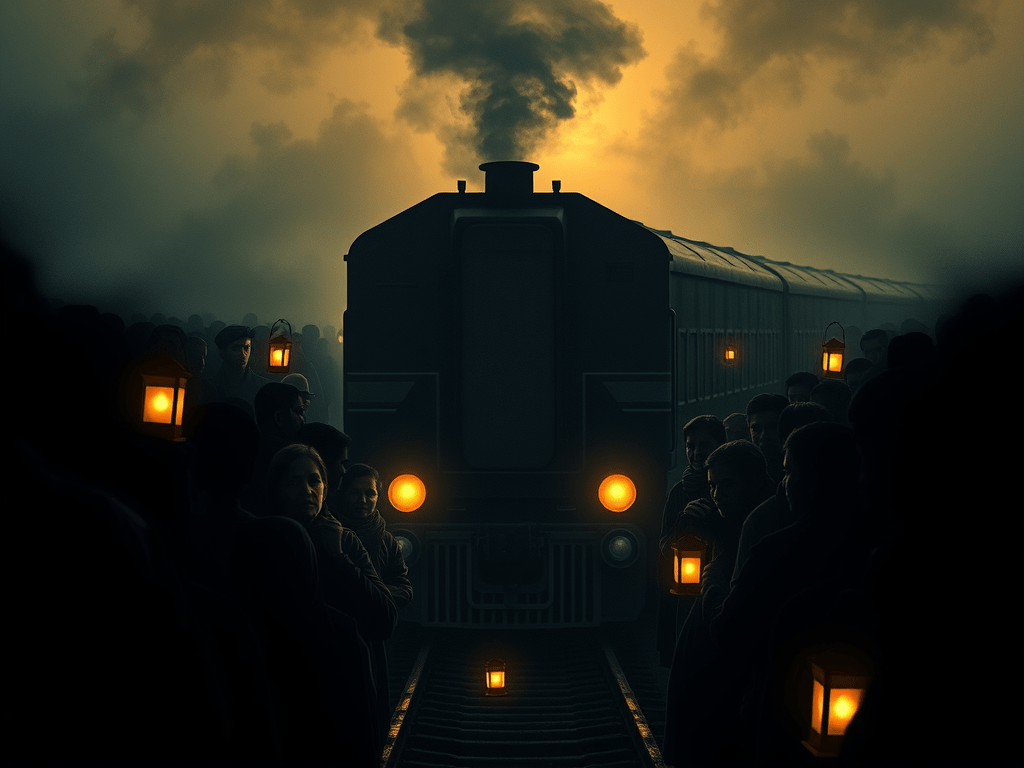
The discussion centres on the film Train to Pakistan and its depiction of the traumatic events surrounding the partition of India. The film contains explicit content due to the violence and gender-based atrocities that were prevalent during this period. It is recommended to watch the film privately, as some scenes may be uncomfortable when viewed with family members. The partition of India serves as the film’s backdrop, and the title Train to Pakistan holds significant symbolic meaning. During the partition, trains played a crucial role in transporting refugees between India and Pakistan. These trains, however, became painful symbols of the period due to the violence and loss of life associated with them.
In partition literature—whether in films, novels, or poetry—the metaphor of the train is often used to reflect both connection and separation. Trains connected regions and communities, but they also symbolized the tragic reality of forced migrations and mass killings. For instance, in Bhisham Sahni’s story Amritsar aa Gaya, the train metaphor highlights the mixed emotions of hope and terror depending on which region the train passes through. Areas with a Hindu majority were seen as safe by Hindus but dangerous for Muslims, and vice versa. The meaning of these places shifted drastically based on religious identity, reflecting the deep-rooted fears of the time.
Before the partition, regions such as Punjab and Haryana had mixed populations of Hindus, Muslims, and Sikhs living together harmoniously, making it difficult to draw rigid boundaries. The division of India, marked by the creation of West Pakistan and East Pakistan, was hastily implemented. The boundary, known as the Radcliffe Line, was drawn within a month by British lawyer Cyril Radcliffe, who had never visited the region. He relied on historical and geographical texts to make decisions about dividing communities that had coexisted for centuries.
The line separated India into Hindu-majority and Muslim-majority regions, but the division did not reflect the complex demographic realities on the ground. It was not a natural or well-considered settlement. Instead, it resulted in widespread violence, displacement, and suffering. Ideally, boundaries between nations should be based on natural geographical features such as rivers or mountains, which tend to minimize disputes. Examples like the natural boundary between the United States and Mexico illustrate this concept. However, in the case of India and Pakistan, the partition was a politically driven decision, leading to contested and conflict-ridden boundaries.
The division of India and Pakistan was not based on natural geographical frontiers or physical boundaries like mountains or rivers, as is common in cases where two land masses or water bodies serve as natural barriers between countries. For instance, the Himalayan range forms a clear boundary between India and China, with defined territories on either side. But the partition of India did not follow this approach. Instead, it involved arbitrary political lines that cut through communities, homes, and even villages.
A clear example of the absurdity of this division is depicted in the film Begum Jaan, which highlights how the Radcliffe Line often split houses, farms, and even courtyards between the two nations. In some cases, one part of a household ended up in India, while the other part was in Pakistan. Such divisions ignored the region’s human geography—how settlements, families, and communities had developed over generations. The boundary did not consider the social and cultural integration of the people, leading to bizarre and painful situations where relatives living in the same village were suddenly citizens of different countries.
These arbitrary boundaries created long-lasting consequences. Families were divided, with one side of the family labelled as Indian and the other as Pakistani. Relationships that had developed over generations were suddenly separated by borders. For example, it was common for individuals to have maternal grandparents living in Pakistan while their paternal relatives remained in India. Marriages often spanned the two nations, with people marrying and settling across borders. This led to what many consider “nonsensical” conditions, where emotional ties were torn apart by political boundaries.
Even today, many families live with this division. Despite the political tensions, special travel passes from Amritsar allow people to visit their relatives across the border, highlighting how deep-rooted these connections remain. While India and Pakistan often view each other through a nationalist lens, ordinary people experience the reality of being divided from their loved ones. Political narratives label the neighbouring country as an enemy or a threat, but for many families, those across the border are relatives, not adversaries.
The politics of nationalism and the lived experiences of common people often stand in stark contrast. Borders drawn on maps cannot erase generations of shared heritage and emotional ties. As an example, areas along the India-Nepal and India-Bangladesh borders show how closely integrated communities can be. In some places, people can casually cross over while playing games, as boundaries hold little meaning in daily life. Marriages frequently occur between people from both sides, and children grow up playing across the borders, blurring the political division.
Saadat Hasan Manto, one of the most significant writers of partition literature, captured these emotional and social complexities in his stories. His works explore how ordinary people dealt with the trauma and absurdity of partition. Manto’s stories remain crucial for understanding the impact of this historical event, as they reveal the deep scars left on individuals and families who were forced to navigate the harsh reality of an artificially divided world.
Saadat Hasan Manto’s stories, though often criticized for their explicit descriptions, serve an important purpose in portraying the horrors of the partition. His explicit depictions are not meant to provoke sensation or titillation but to evoke fear, terror, and discomfort. The violence described in Manto’s stories, particularly against women, reflects the harsh reality of the time when women’s bodies became sites of violence rather than love or intimacy. This violence is central to partition literature, as it represents trauma, fear, and dehumanization, not pleasure or romance.
Manto faced numerous legal challenges in the Karachi High Court, where he was accused of obscenity for the graphic nature of his writing. In court, Manto famously read aloud the explicit content from his stories, forcing listeners to confront the truth behind the violence. His goal was to show that these descriptions were not intended to be obscene but to capture the brutal realities of partition, particularly the violence faced by women. Manto’s works highlight how, during partition, violence replaced any form of human connection, and the descriptions of suffering aim to create empathy rather than disgust.
One of Manto’s most famous stories, Toba Tek Singh, captures the madness and absurdity of partition. The protagonist, a mentally ill man named Bishan Singh, is a prisoner in a mental asylum. He becomes confused when he learns that the asylum, once in India, has now been allocated to Pakistan after the partition. He struggles with the idea that his identity has suddenly shifted overnight—from being an Indian to being a Pakistani—without any logic or personal choice. The story reflects the trauma of displacement and the confusion that many people experienced when their homeland, which they had lived in for generations, was now a foreign land. The title, Toba Tek Singh, is significant because the village itself, much like the protagonist, becomes a metaphor for belonging and displacement.
This is why literature is essential alongside historical study. Historical records often provide numerical data and analytical descriptions—such as “one million people were displaced” or “hundreds of thousands were killed.” But this data does not capture the human suffering, trauma, and personal loss that individuals experienced. For instance, reading about 30 people killed in a stampede or 300,000 people killed during partition may not evoke an emotional response. However, if one of the 30 victims in a tragedy were a member of your family, the data would suddenly become deeply personal. You wouldn’t think of them as part of a number; you would remember them as a brother, mother, or father.
History provides broad overviews of events, but it often fails to convey how common people lived through these traumatic periods. The violence of partition was not limited to battles or official declarations; it permeated every aspect of daily life. Social relations, family dynamics, and community structures were deeply affected. Policies such as the declaration of “enemy properties” in India are examples of how the partition influenced individual lives. Properties left behind by Muslims who migrated to Pakistan were seized by the government as enemy assets. Many wealthy Muslims in India lost their homes and possessions, while Hindus migrating from Pakistan to India faced similar situations with properties they had left behind.
Initially, many people who migrated during partition did not believe they were leaving permanently. They imagined they would return to their homes after a brief period of unrest, thinking the political situation would stabilize within a few months. They packed light and left behind their homes, businesses, and valuables, assuming they would reclaim them soon. But the violence and political decisions made it impossible for most to return. For the people living through it, partition was not a theoretical or strategic political decision; it was a deeply personal and emotional upheaval that tore families apart and uprooted lives.
Manto’s stories, as well as other works of partition literature, emphasize these personal experiences. They show how, at the beginning of the violence, many people underestimated the scale of the tragedy. The initial phase of partition was marked by confusion and disbelief, with many assuming that the violence was temporary. However, as the violence escalated, it became clear that the division was permanent, and the emotional and physical scars of this period would endure for generations.
During the initial phase of partition, many people trusted their neighbours, even those belonging to a different community, and handed over the keys to their homes with the hope that they would return and reclaim their property. This act of trust highlights that not everyone viewed their neighbours as enemies, despite the communal tensions. People left behind their homes, jewellery, utensils, clothing, and entire households in the care of those they believed would safeguard them until they returned. At this stage, the scale of violence had not yet reached its peak, and many still believed in the possibility of reconciliation and peace.
However, as the violence escalated, trust eroded, and the situation changed drastically. When entire communities were branded as “enemies,” their properties were similarly labelled as “enemy property,” which led to severe economic exploitation. Market forces played a significant role during this period. As Muslims migrated from India to Pakistan and Hindus from Pakistan to India, their properties were sold at drastically reduced prices. Trust was replaced by fear, and many people were forced to sell their homes for a fraction of their value. Properties worth thousands of rupees were sold for as little as 50 or 60 rupees because the sellers had no bargaining power. They knew that if they didn’t sell, the property would be seized for free by others or taken over by the government.
This economic exploitation was not limited to one side. In both India and Pakistan, some opportunistic individuals from the majority community took advantage of the chaos. In India, some Hindus took over the properties of Muslim neighbours who had fled, while in Pakistan, some Muslims seized Hindu-owned properties. The violence and exploitation were not one-sided—both communities participated in the atrocities, killing neighbours and seizing their properties in the process. Communal violence does not lend itself to a simple narrative of victims and aggressors; no community was entirely blameless. As seen in stories like Amritsar aa Gaya, the complex nature of partition violence reveals that society is multi-layered and far from homogeneous.
Understanding partition requires acknowledging that while certain individuals incited violence, others within the same communities acted compassionately. Many people risked their lives to protect their neighbours and preserve humanity amidst the chaos. The role of influential figures and leaders during this time was complex. Some acted as catalysts of violence, encouraging hatred and riots, while others worked to maintain peace and prevent atrocities. This dual role highlights the unpredictable nature of human behaviour during communal conflicts.
Partition literature and historical accounts emphasize the need to avoid branding entire communities as enemies. The actions of a few cannot be generalized to represent the collective behaviour of an entire group. Societies are complex, and identities within them are multifaceted. The partition serves as a reminder of the importance of understanding this complexity. When individuals blindly follow divisive ideologies, violence becomes inevitable. Recognizing the nuances in human relationships is essential to prevent future conflicts.
During the partition, individuals and groups often exploited the chaos for personal or political gain. One example of this is the character Murad Ali from Bhisham Sahni’s novel Tamas. Murad Ali, a Muslim, orchestrates a violent communal situation by hiring a Dalit to throw a pig’s carcass near a mosque. This act, considered highly polluting in Islamic tradition, was designed to provoke outrage among Muslims and incite violence against Hindus by making it appear that Hindus were responsible. Murad Ali’s calculated plan demonstrates how manipulation of religious sentiments was a common strategy during communal conflicts.
Similar tactics were employed on both sides of the border. In India, some members of organizations like the Hindu Mahasabha incited violence against Muslims while simultaneously maintaining strategic relationships with them. The dual nature of their involvement—on one hand, promoting division, and on the other, maintaining connections—highlighted how some individuals leveraged violence for political and personal gain.
However, partition narratives also emphasize acts of humanity and compassion that transcended religious divides. Not all Muslims or Hindus were perpetrators of violence. Many risked their lives to protect people of the opposite community. For instance, Hindus sheltered Muslim women, and Muslims did the same for Hindu women. While some situations involved forced abduction, others showcased genuine efforts to provide protection and dignity in a time of chaos.
A notable example of this is the film Pinjar, which portrays the story of Rashid, a Muslim man who initially abducts a Hindu woman named Puro to exact revenge for past injustices. Over time, however, Rashid’s intentions shift, and he tries to give Puro a safe and dignified life despite her sense of alienation and disconnection from her family. The story highlights how, even in violent circumstances, human connections and compassion could emerge.
Another film, Partition, presents a similar theme with a more humanistic approach, devoid of political overtones. In this film, a Muslim girl displaced during partition is taken in by a Hindu boy in India, who eventually marries her. As violence subsides and rehabilitation begins, the girl is allowed to visit her family in Pakistan. However, once there, she is unable to return, prompting her husband to search for her across the border. The tension arises when her brother, initially opposed to her marrying a Hindu, becomes conflicted as he realizes that her marriage was based on care and love, not exploitation.
These stories reveal that partition violence was not just about large-scale atrocities but also about individual struggles, choices, and acts of humanity. Amid the widespread devastation, there were moments of kindness and protection. Films and literature capture the complexity of human emotions during partition, showing that communal violence was not driven by entire communities but often by a few individuals or groups. Humanity persisted, even in the most hostile conditions, highlighting the multi-layered nature of societies during this turbulent period.
The climax of the film Partition highlights the tragic consequences of conflicting emotions and divided loyalties. The final confrontation between the Hindu husband of the Muslim girl and her brother takes place on a bridge over a railway track, symbolizing the deep divisions between families, communities, and nations. During the fight, the husband falls onto the tracks and is hit by an oncoming train, leading to his death. This tragic ending illustrates that human relationships often transcend political and communal identities, yet they are frequently caught in the crossfire of larger conflicts. The story emphasizes that genuine human connections do not need the labels of nationality, religion, or political affiliation.
This message is central to understanding partition literature, films, and stories. Readers and viewers should set aside patriotic or nationalist biases when engaging with these works, as their focus is on human suffering and resilience. Human nature, which remains constant across borders, becomes shaped by the external conditions people face. Partition was not driven by human nature itself, but by the abnormal circumstances of violence, displacement, and betrayal. Therefore, the context is crucial in understanding why individuals acted the way they did.
A compelling example of these abnormal conditions is depicted in the film 1947 Earth, based on Bapsi Sidhwa’s novel Ice Candy Man. The film portrays the horrors of partition through the character of Ice Candy Man, played by Aamir Khan. His transformation from a kind, ordinary man to a vengeful figure reflects how partition’s violence turned normal people into perpetrators of brutal acts. In one scene, a train arrives from Gurdaspur, carrying not just the dead bodies of refugees but also mutilated women whose bodies had been violated. Among the victims is Ice Candy Man’s sister, who was killed and dismembered by Hindu attackers.
This personal loss drives Ice Candy Man into a state of rage and vengeance. When he sees a Hindu village burning, he feels satisfaction, not because he inherently hates Hindus, but because his grief and anger leave him with no other emotional outlet. His reaction exemplifies how violence during partition was fuelled by personal loss and trauma, rather than ingrained hatred. The novel and film highlight that partition was an abnormal time, where the boundaries of morality and humanity blurred due to extreme conditions.
In this abnormal context, actions that would be unthinkable in normal times became common. Women were abducted, raped, forcibly married, or killed during the chaos. Some were later accepted into the households of their abductors and given a semblance of stability, but this was a product of the time’s violence and desperation, not a moral justification. What happened during partition is not applicable to normal times. The atrocities committed then cannot be excused, nor should they be judged by present-day standards without understanding the historical context.
The lesson to take from partition literature is that collective punishment or blame is inappropriate. Not all members of any community were perpetrators of violence, and the conditions of that time cannot be used to judge entire populations. For instance, if a population of 10 lakh people were involved, it would be unjust and impractical to hold them all accountable. Partition literature emphasizes individual stories of suffering, loss, compassion, and survival. It reminds us that human behaviour is deeply influenced by external circumstances, and in times of crisis, even ordinary people can be driven to extraordinary actions. Understanding this complexity is essential to avoid simplifying or generalizing the events of partition.
The partition of India in 1947 was a time when people were driven by a profound sense of insecurity and vulnerability. Many witnessed violence against their families, friends, and communities, leading to emotional trauma and a breakdown of trust. However, it is important to recognize that the violent acts committed during that time were a product of extraordinary circumstances. Today, these acts, if committed, are punishable by law, as they should be, because they no longer exist within the abnormal conditions of partition.
One of the dangerous mindsets that has persisted is the attempt to justify present-day violence by pointing to the atrocities committed during partition. Some argue that because their community suffered in the past, they have the right to retaliate now. This reasoning is flawed and harmful, as modern society is not at war, nor is it experiencing uncontrolled communal violence. Partition was an exceptional event that should not be used as justification for present violence. Today, civil society is much more regulated, and violence is not a general, community-driven phenomenon—it is seen as a personal crime and is dealt with accordingly.
Political leaders have historically exploited communal sentiments to provoke violence, as they did during partition. The events of 1947 spiralled beyond the control of leaders like Nehru and Jinnah. Both tried to mitigate the violence, but the scale of chaos was unprecedented. Jinnah, despite advocating for the creation of Pakistan, originally envisioned a secular state. It was only after his death that Pakistan officially adopted Islam as its national religion and shifted toward an Islamic identity. Blaming any single leader oversimplifies the complex reality of partition, where widespread emotions and mass displacement contributed to uncontrollable violence.
In the present day, we must be cautious not to allow communal tensions to escalate in the same way. We are not living in a time of mass migration or uncontrolled chaos. Violence today is more personal, not community-driven. If an individual commits a crime, it should be treated as an individual act, not as an indictment of an entire community. For example, if a Hindu commits a crime against a Muslim, or vice versa, it is a reflection of personal behaviour, not communal behaviours. Generalizing and blaming entire communities based on the actions of a few individuals is both dangerous and unjust.
Partition literature plays a crucial role in presenting the overlooked side of the narrative. It sheds light on the human cost of violence, the suffering of individuals, and the emotional turmoil that cannot be captured by historical data alone. This literature reveals the complex web of emotions and decisions people faced during partition—decisions that often had little to do with hatred or communal identity, and more to do with survival and fear. Understanding these nuances requires empathy, emotional strength, and the ability to view history beyond its surface-level political interpretations.
Unlike the chaotic, uncontrolled society of partition, today’s civil society is structured and governed by laws meant to protect its citizens. Therefore, creating or perpetuating chaos in the name of past grievances is not only unnecessary but harmful. Partition should be remembered as a historical lesson, not as a blueprint for ongoing violence.
To gain a deeper understanding of these complexities, watching films and reading novels based on partition can provide valuable insights. The film Train to Pakistan, based on Khushwant Singh’s novel, is a powerful depiction of the violence, displacement, and human suffering experienced during partition. It is recommended to watch it privately, as it contains explicit content that reflects the harsh realities of the time. By engaging with such works, we can better appreciate the human cost of partition and avoid repeating the mistakes of the past.

 Literary Latitude