
Harold Pinter (1930-2008) stands as a monumental figure in English dramatic literature, his profound contributions recognized with the Nobel Prize in Literature in 2005 . His distinct theatrical style, often termed “Pinteresque,” is characterized by a sparse yet potent use of language, significant pauses that speak volumes, an underlying sense of menace, and a deep exploration of themes concerning power dynamics, the elusiveness of memory, and the subjective nature of truth . These stylistic elements are not mere artistic choices but are fundamental tools that Pinter employs to unveil the hidden emotions and veiled motivations that drive his characters in works such as Betrayal .
First brought to the stage in 1978, Betrayal is widely considered one of Pinter’s most significant dramatic achievements . What sets this play apart is its innovative narrative structure, employing reverse chronology to meticulously dissect a seven-year extramarital affair involving three individuals . This unconventional approach to storytelling is not simply a stylistic flourish; it profoundly shapes the audience’s perception of causality, the intricacies of memory, and the gradual disintegration of human relationships . In 1983, Pinter’s compelling narrative was adapted for the screen by director David Jones, with Pinter himself crafting the screenplay . This cinematic rendition garnered critical acclaim, largely due to its faithfulness to the source material . This report aims to provide a comprehensive analysis of both the play and its film adaptation. It will delve into a detailed plot summary, offer an examination of the key characters, analyse the significance of the settings and the unique structure, explore the central themes and recurring symbols, and discuss the relevant cultural, historical, and political contexts that inform the work.
The play Betrayal unfolds across nine scenes, presented in a non-linear fashion, moving backward in time from 1977 to 1968 . Within this reverse chronological framework, two specific years, 1977 and 1973, contain scenes that progress forward in time within those respective years . This deliberate manipulation of the timeline disrupts traditional narrative expectations, compelling the audience to reconstruct the emotional journey of the affair, starting from its conclusion and moving towards its genesis .
To provide clarity, the plot summary will be presented in forward chronological order, spanning from 1968 to 1977, detailing the events, characters involved, and locations in each scene.
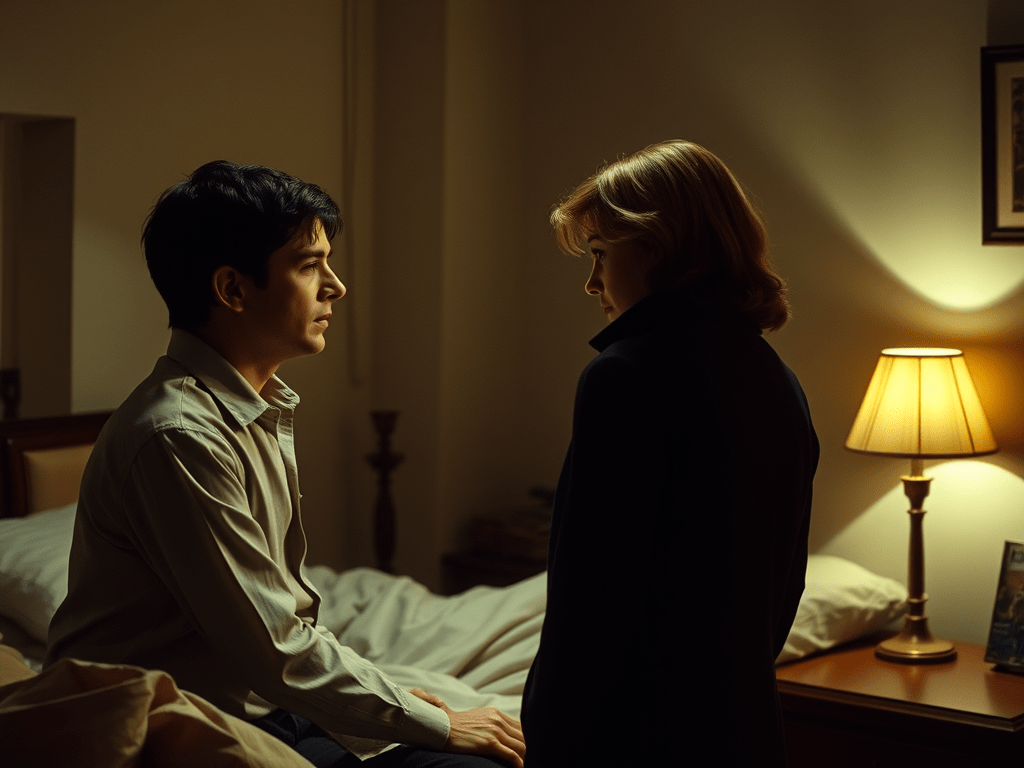
The chronological narrative commences with Scene 9, set in Robert and Emma’s House. Bedroom. 1968. Winter . A party is in progress at the house. Jerry, already under the influence of alcohol, seeks refuge in the bedroom, anticipating Emma’s arrival . When Emma enters, Jerry confesses his long-held affection for her. Initially, Emma resists his advances. Robert then enters the room, and Jerry, in his inebriated state, reminds Robert of their close bond, mentioning that he served as Robert’s best man. After Robert departs, Emma displays the first indication of reciprocating Jerry’s feelings . This initial encounter marks the beginning of the affair, sparked by Jerry’s drunken declaration and Emma’s eventual yielding, suggesting the influence of circumstance and perhaps an underlying dissatisfaction within their respective marriages . Understanding the affair’s origin is crucial for interpreting the subsequent events that unfold in the play.
Scene 8 takes place in the Flat. 1971. Summer . This is the secret apartment rented by Jerry and Emma for their clandestine meetings . During this encounter, Emma inquires whether Jerry’s wife, Judith, suspects their affair. They engage in a discussion about infidelity in general terms, pointedly denying any instances of unfaithfulness to each other within the context of their own affair. Emma then reveals a significant development: she is pregnant with Robert’s child, a conception that occurred while Jerry was in America . This revelation underscores the increasing complexity of their situation, with the pregnancy introducing a substantial layer of entanglement and the potential for further deception. Their denial of infidelity within their own affair highlights the shifting boundaries of loyalty and betrayal within their secret world .
Scene 7 is set in a Restaurant. 1973. Summer . Jerry and Robert are meeting for lunch at a London restaurant . As the scene progresses, Robert becomes visibly drunk and expresses his disdain for modern novels. He casually mentions a recent solo trip he took to Torcello (while Emma had claimed there was a speedboat strike preventing her from joining him), during which he read the works of Yeats . Robert’s inebriated state and his seemingly offhand remark about Torcello subtly hint at his awareness or suspicion of Emma’s deception and the affair itself . This scene showcases his passive-aggressive tendencies and the erosion of genuine communication between the two friends.
Scene 6 returns to the Flat. 1973. Summer . Emma has returned from her holiday in Venice with Robert and has purchased a tablecloth for the flat . During their meeting, Jerry discloses that he continues to have lunch with Robert, despite his ongoing affair with Emma. Emma expresses her unease about this and mentions that Jerry was the one who gave her the book by Spinks (a detail that contradicts Robert’s later claim of rejecting the manuscript directly from Jerry) . Jerry also recounts several close calls where his wife, Judith, nearly discovered their affair . The discrepancy surrounding the Spinks book introduces another layer of deception and underscores the characters’ manipulation of truth. Emma’s act of buying a tablecloth for the flat reveals her deeper emotional investment in their secret world and her desire to create a sense of domesticity within their illicit relationship .
Scene 5 shifts the setting to Venice. Hotel Room. 1974. Summer . Robert and Emma are on holiday in Venice . In this pivotal scene, Robert reveals that he has discovered a private letter from Jerry to Emma at the American Express office, thus uncovering their affair. Emma confesses to the five-year relationship. Robert also mentions that he declined to publish Spinks’ book, which centred on the theme of betrayal . This moment marks Robert’s explicit acquisition of knowledge about the affair, yet his reaction is notably calm and detached . This subdued response suggests a pre-existing awareness or a cynical acceptance of betrayal as an inherent aspect of human interactions.
Scene 4 returns to Robert and Emma’s House. Living Room. 1974. Autumn . Jerry pays a visit to Robert and Emma . During the conversation, Jerry informs them that Casey has left his wife and is now living nearby. Jerry and Robert make tentative plans to play squash, but Jerry mentions his impending trip to New York with Casey. Robert reveals that he has been playing squash with Casey and praises his skills as an opponent. Emma interjects, calling Casey’s latest work “dishonest” . This scene illustrates the awkwardness and superficial normalcy of their interactions in the aftermath of Robert’s discovery. The recurring motif of squash underscores the strained dynamic of the male friendship, and Emma’s comment about Casey’s work hints at a shift in her affections.
Scene 3 takes place once again in the Flat. 1975. Winter . Jerry and Emma meet after a period of months and both acknowledge that the passion in their relationship has waned. They mutually agree to sell the flat. Emma departs in anger, leaving her key with Jerry . This scene signifies the emotional end of the affair, marked by a sense of disillusionment and loss, particularly for Emma, who had harboured hopes for a more substantial connection within their relationship . The decision to sell the flat symbolizes the finality of their separation.
Scene 2 is set in Jerry’s House. 1977. Later the same day as Scene 1 . Jerry, still unsettled by his conversation with Emma in Scene 1, invites Robert to his house. Robert reveals that Emma had, in fact, informed him about their affair four years prior, in 1973. They discuss Casey and the fact that they no longer engage in their regular squash games. Robert also casually mentions his own infidelities during his marriage to Emma . This scene exposes the extent of Robert’s long-term deception and Jerry’s prolonged naivety. Robert’s early knowledge and his own marital infidelities further complicate the dynamics of betrayal and challenge the audience’s initial perceptions of victim and perpetrator .
Finally, Scene 1 takes place in a Pub. 1977. Spring . Emma and Jerry meet for the first time in two years since the end of their affair . Emma informs Jerry that her marriage to Robert has ended and that she told Robert about their affair the previous night (a deliberate lie), after discovering his own infidelities. Jerry mentions Emma’s current affair with Casey . This opening scene, chronologically the last in the narrative, establishes the fractured state of their relationships and introduces Emma’s ongoing manipulation of Jerry. Her fabricated account of telling Robert “last night” sets the stage for the revelations that will unfold in the subsequent (chronologically earlier) scenes .
The 1983 film adaptation of Betrayal, directed by David Jones with a screenplay by Harold Pinter, demonstrates a remarkable fidelity to the play’s structure and dialogue . This close adherence suggests that the film aims to be a faithful cinematic interpretation of Pinter’s original work, rather than a radical departure. The film also unfolds across nine sequences, mirroring the play’s nine scenes, and is presented in reverse chronological order, commencing in 1977 and concluding with Emma and Jerry’s initial encounter in 1968 . The film’s visual medium provides a different lens through which the passage of time and the subtle emotional shifts between the characters can be emphasized, compared to the stage play. The lead roles are portrayed by Jeremy Irons as Jerry, Ben Kingsley as Robert, and Patricia Hodge as Emma, all of whom delivered critically acclaimed performances . These strong performances are essential in conveying the nuanced emotions and unspoken tensions that are characteristic of Pinter’s dialogue. Each of the nine sequences in the film aligns directly with the corresponding scenes of the play in terms of setting, characters, and key plot developments. The film, like the play, meticulously traces the significant moments within the seven-year affair, revealing the intricate web of deceit and its profound emotional repercussions .
The characters in Betrayal form a complex triangle of relationships, each marked by layers of deception and self-interest. Emma stands as the central figure, navigating the roles of wife to Robert and lover to Jerry . Her motivations are often ambiguous, reflecting Pinter’s characteristic resistance to simplistic psychological explanations . Her profession as an art gallery owner could be interpreted as symbolic of her engagement with appearances, perception, and the subtle art of deception, mirroring her role in the affair . Emma takes an active role in initiating the initial post-affair meeting with Jerry and appears to be the one who ultimately precipitates the end of their relationship, suggesting a degree of agency in her choices . Her progression from an affair with Jerry to one with Casey might indicate a pattern of seeking external validation or emotional fulfilment outside the confines of her marriage .
Jerry, Robert’s close friend and Emma’s lover, is portrayed as a literary agent . He embodies the self-deceiving romantic idealist who seemingly fails to fully grasp the implications of his actions . The play’s reverse chronology poignantly exposes Jerry’s increasing naivety as the narrative moves backward, revealing a stark contrast between his later, more jaded self and his earlier passionate, yet perhaps short-sighted, idealism . He is the initiator of the affair, driven by a seemingly impulsive desire for Emma .
Robert, Emma’s husband and Jerry’s best friend, works as a publisher . His character subverts the typical expectations of a betrayed husband. His early knowledge of the affair and his calculated decision to remain silent position him as both a victim and a subtle manipulator within the narrative . Robert’s long-held secret and his own history of infidelities reveal a complex and perhaps cynical perspective on marriage and fidelity, suggesting a deeper understanding of betrayal than either Emma or Jerry initially recognize .
Judith, Jerry’s wife, remains an off-stage presence throughout the play . Her absence emphasizes her unawareness of the affair and underscores the theme of hidden truths and the separate lives the characters lead . Judith’s exclusion from the narrative highlights the secrecy and the limited perspective of the central trio, whose world revolves around their own desires and deceptions.
Casey, an author represented by Jerry and published by Robert, becomes Emma’s lover after her affair with Jerry ends . His presence in the play’s opening scene (chronologically the end) serves as a catalyst for the initial conversation between Emma and Jerry and suggests that the themes of betrayal and infidelity extend beyond the central trio, hinting at a broader commentary on the complexities of human relationships.
The settings in Betrayal are not merely backdrops but contribute significantly to the play’s atmosphere and thematic concerns. The various locations in London and Venice each hold their own symbolic weight. The Pub, the setting for the first scene (chronologically the last), represents a casual space for a strained reconnection and the initial, albeit partially truthful, exchange of information between Emma and Jerry in 1977 . Jerry’s House serves as the location for the confrontation (in reverse chronology) where Robert reveals his long-held knowledge of the affair, highlighting the stark contrast in their understanding of the situation . The Secret Flat, rented by Emma and Jerry, symbolizes their private, self-contained world of illicit romance, a space where they attempted to create a separate reality, and its eventual abandonment marks the demise of their relationship . Emma’s desire to make the flat feel like a “home” underscores her deeper emotional investment in the affair compared to Jerry’s more casual approach . Robert and Emma’s House, with its living room and bedroom, represents the public face of their marriage and the initial site of betrayal, respectively, highlighting the intrusion of the affair into their most intimate space . The Italian Restaurant is a recurring location for Jerry and Robert’s lunches, symbolizing their enduring (at least superficially) male friendship and shared history, a bond ultimately tainted by Jerry’s betrayal . Robert’s continued invitations to lunch, even after knowing about the affair, showcase the complex dynamics of their relationship, potentially involving a mix of resentment, manipulation, and a desire to maintain appearances . Finally, Venice (Hotel Room), a setting often associated with romance, ironically becomes the place where Robert confronts Emma with the evidence of her affair, highlighting the stark contrast between outward appearances and underlying realities . The discovery in Venice, a location typically linked with escape and romance, underscores the impossibility of truly escaping the consequences of betrayal. These contemporary, urban, and affluent settings reflect the social stratum of the characters and perhaps contribute to a sense of detachment or emotional reserve .
The innovative reverse chronological structure of Betrayal has a profound impact on the narrative and the audience’s experience . By beginning at the end of the affair, the play shifts the focus from the anticipation of future events to an examination of the past and the intricate ways in which the relationships unravel . The audience is privy to the outcomes, allowing them to analyse the subtle shifts in power, emotion, and truth that occur in the earlier scenes with a heightened awareness of their eventual consequences . The interweaving of forward movement within the years 1977 and 1973 amidst the overall backward trajectory creates a complex temporal landscape, allowing for moments of immediate aftermath alongside the unfolding of past events, further highlighting the interplay of memory and present reality .
Several key episodes or scenes are particularly revealing in understanding the dynamics of betrayal in the play. The opening scene in the pub (1977) establishes the end of the affair and introduces the complex web of lies and the awkward reunion, setting the stage for the unravelling of their history . The scene at Jerry’s house (1977), where Robert calmly discloses his four-year knowledge of the affair, exposes Jerry’s prolonged deception and Robert’s enigmatic nature . The Venice confrontation in the hotel room (1974), where Robert discovers the letter and Emma admits to the affair, marks a pivotal moment, yet Robert’s restrained reaction is key to his character . The scenes in the secret flat (1971, 1973, 1975) collectively trace the arc of the affair, from the initial passion and shared intimacy to the gradual cooling and eventual termination, highlighting the changing dynamics and emotional landscape of their secret relationship . Finally, the last scene chronologically, set in the bedroom in 1968, depicts the initiation of the affair, providing crucial context for understanding the motivations and underlying tensions that led to the subsequent betrayals .
Table 1: Chronological Order of Scenes/Sequences in the Play and Film with Key Events
| Scene/Sequence | Year | Setting | Main Characters | Key Events |
| 9 | 1968 | Robert and Emma’s House (Bedroom) | Jerry, Emma, Robert | Jerry declares his love for Emma; Emma initially resists but then yields after Robert leaves. |
| 8 | 1971 | Flat | Jerry, Emma | Emma reveals her pregnancy with Robert’s child; they discuss Judith’s potential suspicions. |
| 7 | 1973 | Restaurant | Robert, Jerry | Robert gets drunk, mentions his solo trip to Torcello and reading Yeats. |
| 6 | 1973 | Flat | Jerry, Emma | Emma has returned from Venice; they discuss Robert and the Spinks book; Jerry mentions close calls with Judith. |
| 5 | 1974 | Venice (Hotel Room) | Robert, Emma | Robert reveals he knows about the affair through a letter; Emma admits to it. |
| 4 | 1974 | Robert and Emma’s House (Living Room) | Jerry, Emma, Robert | Jerry mentions Casey’s separation; they discuss squash and Casey’s work. |
| 3 | 1975 | Flat | Jerry, Emma | They acknowledge their love has cooled and decide to sell the flat; Emma leaves her key. |
| 2 | 1977 | Jerry’s House | Jerry, Robert | Robert reveals he knew about the affair for four years and mentions his own infidelities. |
| 1 | 1977 | Pub | Emma, Jerry | Emma tells Jerry her marriage is over and that she told Robert about their affair “last night” (a lie); Jerry mentions Emma’s affair with Casey. |
The central theme of Betrayal is, unsurprisingly, betrayal itself, which manifests in multiple forms throughout the play . Emma’s affair with Jerry constitutes a betrayal of her husband Robert and Jerry’s wife Judith. Simultaneously, Jerry’s involvement with Emma is a profound betrayal of his close friendship with Robert and his marriage to Judith . Furthermore, Robert’s long-held knowledge of the affair, without confronting Jerry, can also be interpreted as a betrayal of their friendship . The play demonstrates that betrayal is not a singular act but rather a complex web of decisions and consequences that permeates all the relationships depicted . It even suggests that the very capacity for love might sometimes be intertwined with the act of betraying others, and perhaps even oneself .
The nature of the relationship between Emma and Jerry raises questions about love and lust . The reverse chronology allows the audience to observe the affair’s progression from its emotionally detached end to its passionate beginning, prompting reflection on whether their connection was rooted in genuine love, fleeting passion, or a search for something absent in their respective marriages .
Memory and time are intrinsically linked to the play’s structure and themes . The reverse chronology foregrounds the subjective and often unreliable nature of memory . The characters’ differing recollections of past events highlight how memory can be influenced by individual perspectives and emotional biases, further complicating the notion of objective truth . The play also suggests that the significance of past events can shift depending on present knowledge, an effect amplified by the non-linear structure .
Truth and deception are pervasive throughout the play . The characters consistently manipulate information to protect themselves and their relationships. Even seemingly minor lies contribute to a larger web of deceit, eroding trust and creating emotional distance . Emma’s fabrication about informing Robert “last night” is a prime example of this .
Subtle power dynamics also play a significant role in the interactions between the characters . These power struggles often manifest through the control and withholding of information. Robert’s early awareness of the affair grants him a considerable, albeit understated, power over both Emma and Jerry, influencing his actions and reactions throughout the play . His decision to remain silent and observe their deception is a clear demonstration of this power .
Several recurring symbols enrich the thematic complexity of Betrayal. The Italian Restaurant can be seen as representing the enduring (at least superficially) male friendship between Robert and Jerry, a bond that persists despite the betrayal, highlighting the intricate nature of male relationships and the potential for compartmentalization . Robert’s continued invitations to lunch, even after knowing about the affair, could be interpreted as a form of passive aggression or a manifestation of his complex feelings towards Jerry . The Secret Flat symbolizes Emma and Jerry’s attempt to create an idealized, separate world for their affair, a space of intimacy and escape from their marital realities . Its eventual sale signifies the failure of this endeavour and their return to their respective “homes” . Emma’s desire to furnish and personalize the flat with items like a tablecloth suggests her longing for a more permanent and meaningful connection within the affair, contrasting with Jerry’s more pragmatic view of the space . The Book by Spinks, which Robert refuses to publish because “there is not much more to say about betrayal,” is a moment of dramatic irony, given the play’s central theme . It could symbolize Robert’s cynical perspective on the topic or his attempt to distance himself from the very subject that defines his own situation . The fact that Jerry, the betrayer, is Spinks’ agent adds another layer of irony, highlighting the interconnectedness of their professional and personal lives . The Game of Squash represents male camaraderie and competition between Robert and Jerry . The cessation of their squash games after Robert discovers the affair signifies the breakdown of their friendship and the irreparable damage caused by Jerry’s betrayal . Robert’s repeated, almost insistent, invitations to play squash after learning of the affair could be interpreted as a subtle form of psychological manipulation or a poignant reminder of what they have lost . Finally, Robert’s solitary trip to Torcello and his reading of Yeats can be seen as symbolic of his search for meaning or solace outside of his fractured relationships . Yeats, a poet often concerned with memory and the past, resonates with the play’s themes . Emma’s lie about the speedboat strike preventing her from joining Robert in Torcello highlights the breakdown of trust and communication within their marriage, further emphasizing Robert’s isolation .
Betrayal emerged within the cultural context of 1970s Britain, a period marked by significant social changes and evolving attitudes towards marriage, fidelity, and personal freedom, influenced by the preceding cultural shifts of the “Swinging Sixties” . The increased social permissiveness and the liberalization of divorce laws during this time might provide a backdrop for understanding the characters’ choices and the relative lack of overt social condemnation of their affair within the play’s world . The play’s focus on the affluent, professional middle class in London potentially offers a glimpse into the values and concerns of this social group during that era .
Historically, Betrayal draws significant inspiration from Pinter’s own seven-year clandestine affair with Joan Bakewell, underscoring the semi-autobiographical nature of the play and the close parallels between the fictional characters and real individuals . Understanding the real-life origins of the play provides valuable insight into Pinter’s personal exploration of betrayal, memory, and the complexities of his own relationships . The initial misinterpretation of the play as reflecting Pinter’s later affair with Antonia Fraser highlights the public’s interest in the connection between his life and his art . Betrayal can also be contextualized within Pinter’s broader body of work, particularly within his “Memory Plays” period, where the exploration of the past and the unreliability of recollection takes centre stage .
While Betrayal is primarily a personal drama, the potential influence of Pinter’s well-known leftist political views should be considered . Some critics argue that Pinter’s political leanings might subtly inform his portrayal of the characters’ bourgeois lives and their apparent detachment from broader social and political issues, suggesting a critique of their complacency and self-absorption . However, other perspectives suggest that Betrayal is primarily focused on the intricacies of personal relationships and the universal themes of love, loss, and deception, with Pinter’s political concerns taking a backseat in this particular work . Pinter’s history of political activism, including his involvement in the Campaign for Nuclear Disarmament and his outspoken criticism of political injustices in his later years, remains a significant aspect of his public persona .
In conclusion, Betrayal stands as a powerful and enduring work in modern drama, skillfully adapted for the screen. Through its innovative reverse chronological structure, Pinter dissects the intricate web of betrayal that entangles the lives of Emma, Jerry, and Robert. The play delves into complex themes of love, lust, memory, truth, and power, revealing the subtle ways in which individuals deceive themselves and others. The recurring symbols and the exploration of the cultural and historical context of the time further enrich the play’s meaning. The enduring appeal of Betrayal lies in its insightful exploration of universal human experiences, particularly the devastating impact of betrayal on personal relationships, ensuring its continued relevance for contemporary audiences. Both the play and the film adaptation have garnered critical acclaim, solidifying Betrayal’s place as a significant contribution to modern literature and cinema.



 Literary Latitude