
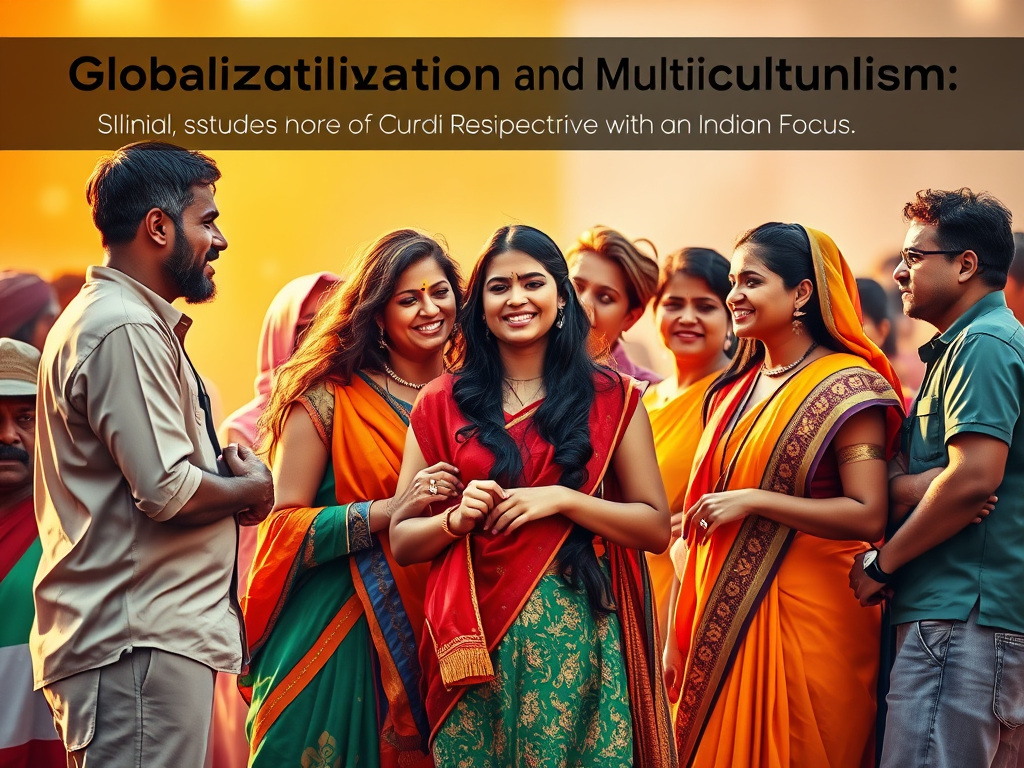
Globalization, a multifaceted phenomenon with ancient roots, has profoundly impacted societies worldwide, particularly in the realm of culture. This article delves into the concept of globalization within the framework of cultural studies, exploring its various theories, key critics and thinkers, and their perspectives. It further examines the intricate relationship between globalization and multiculturalism, with a specific focus on India and its unique cultural landscape.
Defining Globalization in Cultural Studies
Globalization signifies the increasing interconnectedness and exchange of ideas, values, and cultural practices across national borders. It involves the transmission of cultural symbols, meanings, and values worldwide, leading to transformations in local cultures and identities. This process is facilitated by advancements in communication technology, international travel, and the global flow of media and popular culture.
Cultural globalization is not merely a homogenizing force; it also involves the hybridization of cultures, where different cultural elements blend and create new forms of cultural expression. This dynamic interplay between homogenization and hybridization shapes the cultural landscape in the era of globalization.
To understand the historical context of globalization, it’s crucial to recognize its evolution through distinct phases. Scholars suggest that globalization can be traced back to early civilizations, with a pre-modern phase extending from early human migration and the emergence of world religions to the development of trans-regional trade networks like the Silk Road. The modern phase, marked by European imperialism and the rise of the West, witnessed the spread of modernity, industrialization, and the nation-state, further accelerating cultural diffusion and interconnectedness.
Theories of Globalization in Cultural Studies
Several theories attempt to explain the complex dynamics of cultural globalization. Some prominent ones include:
- Cultural Imperialism: This theory suggests that globalization leads to the dominance of Western, particularly American, culture over other cultures, resulting in the erosion of cultural diversity and the imposition of a homogenized consumer culture. Critics argue that this cultural dominance can lead to the marginalization and potential extinction of local traditions and identities.
- Media Imperialism: A subset of cultural imperialism, this theory focuses on the role of media conglomerates in shaping global culture. It argues that a small number of Western media companies control the production and distribution of information and entertainment, leading to the dissemination of Western values and ideologies worldwide.
- Hybridization: This theory, proposed by Jan Pieterse, suggests that cultural globalization is a long-term historical process of cultural mixing and integration. It emphasizes the blending of cultural elements from different societies, leading to the creation of new hybrid forms. This perspective views globalization as a dynamic process of cultural exchange and innovation.
- Glocalization: This concept highlights the adaptation of global products or services to local markets and cultures. It recognizes that globalization is not a uniform process and that local cultures play an active role in shaping the impact of global forces.
- World-Systems Theory: This theory, rooted in Marxist thought, views globalization through the lens of economic and political power relations. It argues that the global system is divided into core, periphery, and semi-periphery countries, with core countries dominating the global economy and culture.
These theories offer different perspectives on the dynamics of cultural globalization. While cultural and media imperialism theories highlight the potential for homogenization and cultural dominance, hybridization emphasizes the creative blending of cultures and the emergence of new forms. Glocalization recognizes the agency of local cultures in adapting global influences, while world-systems theory provides a critical lens for understanding the power dynamics inherent in globalization. Each theory contributes to a more nuanced understanding of the complex interplay between global and local forces in shaping cultural landscapes.
Key Critics and Thinkers
Numerous scholars have contributed to the understanding of globalization in cultural studies. Some key figures and their views include:
- Anthony Giddens: Giddens argues that globalization is a complex and multidimensional process driven by technological advancements, economic integration, and political changes. He emphasizes the role of globalization in transforming social relations and institutions.
- Manuel Castells: Castells focuses on the impact of information and communication technologies in shaping the network society. He argues that globalization is creating a new form of social organization characterized by interconnectedness and flows of information.
- Immanuel Wallerstein: Wallerstein’s world-systems theory provides a critical perspective on globalization, highlighting the unequal distribution of power and resources in the global system.
- Arjun Appadurai: Appadurai explores the cultural dimensions of globalization, focusing on the flows of people, ideas, and technologies across borders. He emphasizes the role of imagination and cultural flows in shaping global landscapes.
- Ulf Hannerz: Hannerz examines the concept of cosmopolitanism in the context of globalization, arguing that globalization leads to the emergence of global subcultures and transnational networks. He suggests that globalization encourages cosmopolitan engagement, where individuals interact and connect across cultural boundaries, fostering a sense of global citizenship and shared values. This perspective highlights the potential for globalization to promote intercultural understanding and cooperation.
- Roland Robertson: Robertson emphasizes the cultural aspects of globalization, arguing that it involves both the compression of the world and the intensification of global consciousness.
Multiculturalism in India: A Cultural Studies Perspective
India, with its rich and diverse cultural heritage, provides a compelling case study for examining multiculturalism in the context of globalization. India is a land of multiple religions, languages, ethnicities, and cultural practices. This inherent multiculturalism has been shaped by historical interactions, trade, and cultural exchanges over centuries. Each cultural artifact in India, from ancient temples to traditional crafts, represents a piece of the country’s collective memory, connecting the present to the past. However, in today’s globalized world, preserving this heritage comes with challenges. Efforts to conserve and interpret cultural artifacts must keep pace with the pressures of modernization and development.
Examples of Multiculturalism in India:
- Religious Diversity: India is home to major religions like Hinduism, Islam, Buddhism, Sikhism, Christianity, and Jainism, as well as numerous indigenous faiths and folk traditions. This religious pluralism is reflected in the diverse places of worship, festivals, and cultural practices across the country.
- Linguistic Diversity: India has more than a thousand different languages and dialects, with 22 officially recognized languages. This linguistic diversity is a testament to the country’s multicultural nature and poses challenges for communication and national integration.
- Cultural Hybridity: Globalization has further intensified cultural exchange and hybridization in India. Examples include the fusion of musical traditions, such as the blending of Indian classical music with Western genres, the blending of culinary styles, leading to the creation of dishes like “Butter Chicken,” and the adoption of global fashion trends while retaining local aesthetics, such as the fusion of traditional Indian garments with Western styles. More relatable examples include the use of “Hinglish,” a hybrid language combining Hindi and English, the emergence of “Indo-Western wear,” and the fusion of wedding practices, where traditional Indian rituals are combined with Western elements like bachelorette parties.
- Cultural Resistance and Preservation: Alongside hybridization, there are movements aimed at preserving indigenous languages and cultural traditions in response to the homogenizing forces of globalization. These movements reflect the ongoing negotiation between global and local cultures in India. For example, tribal communities in India have actively engaged in resistance movements to protect their natural resources, cultural practices, and traditional ways of life. These movements often involve protests against deforestation, land acquisition, and displacement caused by development projects, highlighting the interconnectedness of cultural preservation and environmental conservation.
Cultural Resistance and Preservation Movements
Tribal communities in India have a long history of resistance and preservation movements aimed at protecting their cultural heritage and natural resources. These movements are often rooted in the close interconnection between tribal societies and their environment, where cultural practices, religious beliefs, and economic activities are deeply intertwined with the natural world.
Examples of such movements include:
- Forest Rights Movements: Tribal communities have been at the forefront of movements to secure their rights over forests and forest resources. These movements challenge policies that restrict their access to traditional lands and resources, advocating for sustainable use and community-based conservation.
- Anti-Displacement Movements: Tribal communities have resisted displacement caused by large-scale development projects, such as dams, mines, and industrial zones. These movements highlight the social and cultural costs of development, advocating for the rights of indigenous peoples to their ancestral lands and traditional ways of life.
- Agrarian Unrest: Tribal communities have engaged in protests and movements related to land rights, agricultural practices, and access to resources. These movements often address issues of land alienation, unfair pricing of agricultural produce, and the impact of globalization on traditional farming practices.
These movements demonstrate the resilience of tribal cultures in the face of globalization and development pressures. They highlight the importance of recognizing the rights of indigenous peoples, protecting their cultural heritage, and ensuring their participation in decision-making processes that affect their lives and livelihoods.
Analyzing Multiculturalism through the Lens of Cultural Studies:
Cultural studies provides a framework for understanding the complexities of multiculturalism in India by considering:
- Power Dynamics: Cultural studies analyzes how power relations influence cultural interactions and the representation of different cultural groups in India. It examines how globalization may exacerbate existing inequalities or create new forms of cultural dominance.
- Identity Formation: Cultural studies explores how globalization impacts the formation of individual and collective identities in India. It examines how individuals negotiate their identities in a multicultural society undergoing rapid social and cultural change.
- Representation and Discourse: Cultural studies analyzes how different cultural groups are represented in media, literature, and popular culture in India. It examines how globalization influences these representations and the discourses surrounding multiculturalism.
Globalization’s Impact on Indian Culture
Globalization has had a profound impact on various aspects of Indian culture, bringing both opportunities and challenges:
Family Structure and Social Norms:
- Positive Impacts: Globalization has led to increased awareness of gender equality and women’s rights, contributing to greater empowerment and opportunities for women in India.
- Negative Impacts: Globalization has been associated with the erosion of traditional family structures, such as the joint family system, and the rise of individualism, which can challenge traditional values and social cohesion.
Language:
- Positive Impacts: Globalization has promoted multilingualism and increased access to global communication, facilitating cultural exchange and economic opportunities.
- Negative Impacts: The dominance of English in a globalized world can lead to the marginalization of indigenous languages and the loss of cultural identity.
Religion:
- Positive Impacts: Globalization has facilitated interfaith dialogue and increased religious tolerance, promoting understanding and respect for diverse belief systems.
- Negative Impacts: Globalization can lead to the spread of religious fundamentalism and intolerance, as well as the commercialization of religious practices.
Food and Cuisine:
- Positive Impacts: Indian cuisine has gained global popularity, with dishes like curry and biryani becoming international favourites. This has contributed to the growth of the Indian food industry and the spread of Indian culinary traditions worldwide. The popularity of curry across Asia has even led to it being labelled as a “pan-Asian” dish, highlighting the influence of Indian cuisine on regional culinary traditions.
- Negative Impacts: The globalization of food culture has also led to the rise of Western fast-food chains in India, which can impact traditional eating habits and contribute to health issues.
The Arts and Entertainment:
- Positive Impacts: Globalization has provided a platform for Indian artists, musicians, and filmmakers to reach global audiences, promoting cultural exchange and appreciation for Indian art forms.
- Negative Impacts: The dominance of Western media and entertainment can overshadow local artistic expressions and contribute to the homogenization of cultural tastes.
The Elderly:
- Negative Impacts: Globalization can create challenges for the elderly in India, as traditional family support systems may weaken and social changes can lead to marginalization and isolation.
Globalization and India’s Social Structures:
Globalization interacts with India’s existing social structures in complex ways. For example, while globalization has contributed to economic growth and social mobility, it has also exacerbated existing inequalities and created new forms of social stratification. The rise of English as a global language has further emphasized linguistic hierarchies and impacted access to education and employment opportunities. Globalization has also influenced the caste system, with increased economic opportunities and new job types challenging traditional social hierarchies and leading to greater social mobility.
Glocalization, Grobalization, and NGOs:
While glocalization highlights the adaptation of global influences to local contexts, the concept of “grobalization” introduced by sociologist George Ritzer emphasizes the pressure exerted by organizations and nations to expand globally, potentially imposing themselves on local cultures. This can be seen in the dominance of global brands and the standardization of consumer experiences. However, alongside these forces, NGOs play a crucial role in promoting cultural preservation and diversity. Organizations like Cultural Survival work to protect the cultural traditions of indigenous groups in the developing world, advocating for their rights and raising awareness about the importance of cultural diversity.
Indian Culture’s Influence on the Globe
India has a long history of cultural exchange with the world, and its cultural influence can be seen in various domains, from religion and philosophy to cuisine and the arts.
- Spread of Buddhism: Buddhism, which originated in India, spread across Asia and beyond, influencing religious and philosophical thought in various cultures.
- Yoga and Meditation: Practices like yoga and meditation, with roots in ancient Indian traditions, have gained global popularity, embraced for their holistic benefits and adopted by individuals and wellness industries worldwide.
- Indian Cinema: Indian films, particularly Bollywood movies, have acquired a global following, captivating audiences with their unique blend of music, dance, and storytelling.
- Ancient Trade Routes: In ancient times, Indian traders and scholars travelled extensively, establishing cultural links and disseminating knowledge and religious ideas. The Silk Road, for example, served as a conduit for the transmission of Buddhism, Indian philosophy, and cultural practices to different parts of Asia.
These examples demonstrate the enduring influence of Indian culture on the global landscape.
Government Initiatives for Heritage Conservation
The Indian government has implemented various initiatives aimed at preserving and promoting the country’s cultural heritage. These initiatives recognize the importance of cultural heritage for national identity, social cohesion, and sustainable development.
| Initiative | Description |
| Kashi Culture Pathway | Adopted at the G20 Culture Ministerial Meeting in 2023, this initiative addresses threats to cultural heritage and promotes international cooperation for cultural preservation. |
| Indian Institute of Heritage | Established in Noida, this institution focuses on conservation and research in India’s rich tangible heritage. |
| PRASAD Scheme | Pilgrimage Rejuvenation and Spiritual Augmentation Drive aims to develop and beautify pilgrimage destinations across India. |
These initiatives demonstrate the government’s commitment to safeguarding India’s cultural heritage for future generations.
Conclusion
Globalization is a complex and dynamic process that has significantly impacted Indian culture. While it has brought economic growth and increased interconnectedness, it has also raised concerns about cultural homogenization, the erosion of traditional values, and the loss of indigenous knowledge. India’s response to globalization has been characterized by both embracing global influences and actively preserving its unique cultural heritage. This response involves navigating the challenges and opportunities of globalization while maintaining a strong sense of cultural identity.
India faces the task of balancing the benefits of globalization, such as economic growth and cultural exchange, with the need to protect its diverse cultural heritage and address the potential negative impacts of homogenization and cultural dominance. This requires a nuanced approach that considers the perspectives of various stakeholders, promotes intercultural dialogue, and fosters a sense of shared responsibility for preserving India’s rich cultural heritage in a globalized world.



 Literary Latitude