
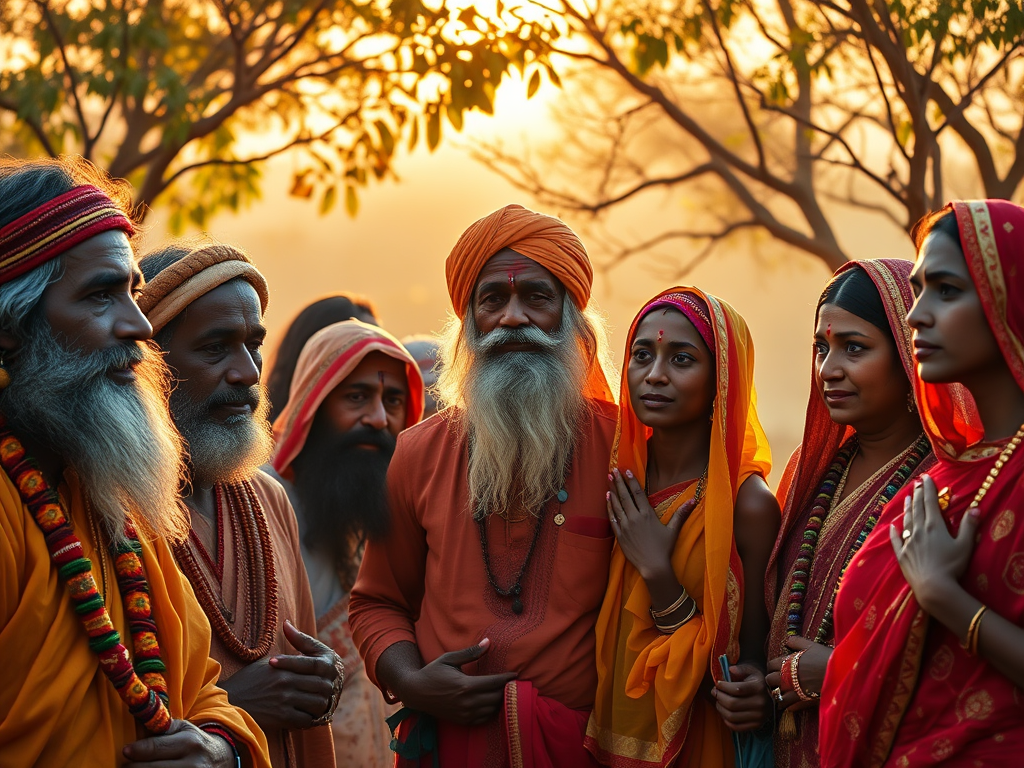
The Bhakti movement was a significant socio-religious reform movement in India that emerged in the medieval period, roughly between the 7th and 17th centuries. It emphasized personal devotion (bhakti) to a single deity as a means to attain spiritual enlightenment. This movement, often described as a “quiet social revolution” 1, challenged the established social and religious norms of the time and had a profound impact on the cultural and religious landscape of India2.
Historical Context
The Bhakti movement originated in South India between the 7th and 12th centuries, with the emergence of the Alvars and Nayanars. The Alvars were poet-saints devoted to Vishnu, while the Nayanars were devoted to Shiva. They travelled from place to place singing hymns in Tamil praising their gods2. The movement gradually spread northwards, appearing in philosophical texts like the 10th-century Bhagavata-purana 3 and gaining significant momentum in the 15th and 16th centuries4.
Several factors contributed to the rise of the Bhakti movement. The decline of Buddhism and Jainism created a need for spiritual renewal within Hinduism5. The arrival of Islam in India brought new ideas of equality and direct devotion to God, which influenced Hindu reformers to challenge rigid rituals and caste-based hierarchies5. Political fragmentation in many parts of India also allowed the movement to spread as spiritual leaders attracted followers from different regions5.
One might see the Bhakti movement as a response to the instability and uncertainty of the era. With the fall of large empires and the rise of regional powers, the political landscape was fragmented, leading to social and religious upheaval1. In this context, the Bhakti movement’s emphasis on personal devotion and the accessibility of salvation may have offered a sense of solace and hope to people facing these challenges6.
Socio-Political Background
The Bhakti movement emerged during a period of significant political and social changes in India. The early medieval period saw the decline of large empires and the rise of regional powers1. This political fragmentation led to diverse cultural and religious developments1.
The movement had a profound impact on the socio-political landscape of India. It challenged the rigid caste system and promoted the idea of equality before God2. Bhakti saints like Kabir and Namdev advocated for the rights of the marginalized and encouraged people to see beyond caste and class distinctions6. While the movement did not completely eliminate caste distinctions, it promoted inclusivity and fostered a sense of community and collective devotion, breaking down some traditional barriers5.
The Bhakti movement also had a significant impact on women. It encouraged women’s participation in religious activities and challenged societal attitudes towards women’s rights and education6. Saints like Mirabai emerged as prominent figures, defying social norms and expressing their devotion through their writings and actions.
Furthermore, the movement inspired local leaders to advocate for social justice and equality6. It led to the formation of new political identities based on shared spiritual beliefs and encouraged a sense of unity among people, regardless of their caste or religion. This challenged the existing power structures and contributed to social resistance against unjust rulers and practices6.
The Bhakti movement also played a role in creating alternative livelihoods for those marginalized by society6. Many followers of the Bhakti saints found new ways to earn a living through local crafts and trades, which helped reduce poverty among lower castes and marginalized groups6.
Religious Background
The Bhakti movement arose amidst the dominance of Brahmanical orthodoxy and complex religious rituals2. The existing religious traditions emphasized rituals, sacrifices, and the intermediary role of priests2. However, the Bhakti movement sought to simplify religious practices and establish a direct, personal relationship between the individual and the divine2.
The movement was characterized by its emphasis on personal devotion to a deity as the path to salvation, rather than through rituals, sacrifices, or the intermediary of priests2. The word ‘bhakti’ itself means ‘devotion’ or ‘love’ in Sanskrit2. This emphasis on devotion allowed individuals from all social backgrounds, including women and lower castes, to express their spirituality and connect with God directly2.
Within the Bhakti movement, two main sects emerged: the Varkaris and the Dharakaris7. The Varkaris were mild devotees of God Vitthala of Pandharpur, who were more emotional, theoretical, and abstract in their viewpoint. The Dharakaris, on the other hand, were heroic followers of the cult of Ramadasa, the devotee of God Rama, who were more rational, concrete, and practical in their thoughts7.
Major Trends in Thoughts and Philosophy
The Bhakti movement encompassed a wide range of philosophical ideas and beliefs. One of the key trends was the concept of a personal God who could be directly worshipped with love and devotion5. This contrasted with the abstract and impersonal nature of the divine in some traditional Hindu philosophies5.
Another important trend was the rejection of rituals and emphasis on inner devotion, love, and faith as the primary means of attaining salvation5. Bhakti saints advocated for a simple, pure life, emphasizing humility and surrender to God5.
The movement also promoted the use of vernacular languages in religious literature and practices, making them accessible to the masses2. This led to the development of regional literature and contributed to the growth of local languages2.
The Bhakti movement is also notable for its two main groups: the Saguna and Nirguna bhakti traditions8. Saguna bhakti refers to devotion towards a deity with form, attributes, and a specific identity, such as Rama or Krishna. Nirguna bhakti, on the other hand, refers to devotion towards a formless, abstract, and attributeless God8. These two traditions represented different approaches to understanding and experiencing the divine within the Bhakti movement.
Major Thinkers and Their Works
The Bhakti movement was led by numerous saints and thinkers across India, each contributing uniquely to its ideals and spreading its message. Some of the major figures include:
- Shankaracharya (c. 788 – 820 CE): A philosopher and theologian who propounded the Advaita philosophy, emphasizing the oneness of the individual soul with the ultimate reality (Brahman). He is said to have been a child prodigy who renounced worldly life at an early age9. He wrote commentaries on the Bhagavad Gita, the Brahma Sutra, and the Upanishads7.
- Ramanuja (c. 1017 – 1137 CE): A philosopher and theologian who advocated the philosophy of Vishishtadvaita (qualified monism), emphasizing the individual soul’s eternal distinction from Brahman while also being an integral part of it. He was born in Sriperumbudur near modern Chennai and opposed the Advaita philosophy of Shankaracharya9. He wrote Sribhashya, Vedanta dipa, Gita Bhasya, and Vedantasara9.
- Madhvacharya (c. 1238 – 1317 CE): A philosopher and theologian who propounded the Dvaita (dualism) philosophy, emphasizing the eternal distinction between the individual soul and Brahman. He was a prominent figure in the Kannada-speaking region and is known for his staunch rejection of caste distinctions and the authority of the Vedas10.
- Kabir (1440–1518): A mystic poet and saint who challenged religious dogma and emphasized direct experience of the divine. He criticized both Hinduism and Islam, advocating for a formless God and denouncing rituals and caste distinctions. His humble origins as a weaver contributed to his appeal among the common people11. His verses are included in the Sikh scripture Guru Granth Sahib11.
- Mirabai (1498-1546): A Rajput princess who became a devotee of Krishna, known for her passionate devotional songs (bhajans). She defied social norms and dedicated her life to her devotion, facing opposition from her family and society12.
- Tulsidas (1532-1623): A poet and devotee of Rama, best known for his epic Ramcharitmanas, a retelling of the Ramayana in Hindi. His works played a significant role in popularizing Rama bhakti in North India. He was a contemporary of Akbar and is said to have had a vision of Hanuman13.
- Guru Nanak (c. 1469 – 1539 CE): The founder of Sikhism, who preached a message of devotion to one God and rejected rituals and caste distinctions. He emphasized the importance of living an ethical life and serving humanity. He was a social reformer and a revolutionary activist who spoke out against injustice and inequality14.
These are just a few of the many influential figures who shaped the Bhakti movement. Their works continue to inspire and resonate with people across India and beyond.
A Glimpse of Their Works
The Bhakti saints expressed their devotion and philosophy through various literary forms, including hymns, poems, and songs. Their works often employed metaphors and imagery drawn from everyday life and human relationships to convey spiritual truths15.
For example, Kabir’s dohas (couplets) are known for their simple language and profound insights into the nature of God and the path to salvation. He often used metaphors of weaving to illustrate his teachings11. Here’s an example of his verse:
“The thread of love, if spun unbroken,
Can mend the tattered fabric of our lives.
But when the thread is snapped by hate and greed,
No needle can repair the damage done.”
Mirabai’s bhajans express her intense love and longing for Krishna, using the metaphor of a lover and beloved16. Here’s a glimpse of her poetry:
“My heart is filled with longing for my Beloved,
Like a thirsty deer yearning for the cool stream.
I wander through the forests of this world,
Seeking the solace of His divine presence.”
Tulsidas’s Ramcharitmanas narrates the story of Rama in a way that emphasizes devotion, duty, and the importance of righteous conduct16. Here’s an excerpt from his work:
“Rama, the embodiment of truth and virtue,
Is the beacon of hope for all mankind.
His life is a testament to the power of dharma,
And his name is a source of endless grace.”
The works of the Bhakti saints were not only religious but also literary masterpieces. They contributed significantly to the development of regional languages and literature, making spiritual teachings accessible to the common people2.
Excerpts from Bhakti Literature
To further illustrate the Bhakti saints’ expressions of devotion and philosophy, here are some excerpts from their works:
Kabir:
“If God be within the mosque, then to whom does this world belong?
If Ram be within the image which you find upon your pilgrimage,
then who is there to know what happens without?” 7
Mirabai:
“Clouds that spill lovely pearls,
what message has the dark-hued lord of Venkatam sent through you?
The fire of desire has invaded my body, I suffer.
I lie awake here in the thick of night, a helpless target for the cool southern breeze.” 7
Lalla (Lal Ded):
“Love-mad, I, Lalla, started out, spent days and nights on the trail.
Circling back, I found the teacher in my own house.
What brilliant luck, I said, and hugged him.” 17
These excerpts offer a glimpse into the diverse expressions of devotion and the profound insights found in Bhakti literature.
Regional Expressions of Bhakti
The Bhakti movement manifested in various forms across different regions of India, influenced by local languages, traditions, and cultural contexts. In Maharashtra, the movement was characterized by a more profound, unitary, and liberal approach to social reforms5. The Varkari tradition, centered on the worship of Vithoba (an avatar of Krishna), became prominent in this region, with followers performing pilgrimages to the Vithoba temple in Pandharpur5.
In South India, the Bhakti movement was led by the Alvars and Nayanars, who emphasized the concept of love between the devotee and God and rejected austerities5. Their devotional hymns in Tamil laid the foundation for the movement’s spread across India5.
Further Reading
For those interested in delving deeper into the Bhakti movement, here are some scholarly articles and books that provide valuable insights:
Scholarly Articles:
- “Bhakti Movement in India: A Catalyst of Cultural Change” 18
- “The Bhakti Movement- A historiographical Critique” 19
- “From Temples to Texts: An Evolutionary Journey of Bhakti Movement in Indian Literatures” 20
Books:
- A Storm of Songs: India and the Idea of the Bhakti Movement 21
- The Bhakti Movement: Renaissance or Revivalism? 22
- Three Bhakti Voices: Mirabai, Surdas, and Kabir in Their Time and Ours 23
These resources offer a deeper understanding of the Bhakti movement’s history, philosophy, and impact on Indian society and culture.
Conclusion
The Bhakti movement was a transformative force in medieval India. It challenged social norms, revitalized religious practices, and left a lasting legacy on Indian culture and society. Its emphasis on personal devotion, equality, and the use of vernacular languages made it a truly popular movement that resonated with people from all walks of life. The teachings of the Bhakti saints continue to inspire and guide spiritual seekers today, reminding us of the power of love, devotion, and the pursuit of inner transformation.
Moreover, the Bhakti movement played a crucial role in promoting interfaith dialogue and harmony between Hindus and Muslims6. By emphasizing the universality of spiritual experience and the importance of inner devotion over religious dogma, the movement fostered a spirit of tolerance and understanding between different religious communities.
While the Bhakti movement had a significant impact on Indian society, it is important to acknowledge its limitations and criticisms. Some scholars argue that the movement did not fully challenge the caste system, as it continued to exist within Bhakti communities4. Others point to the potential for Bhakti to be used for political purposes, as seen in the influence of Bhakti saints on some rulers and political leaders24.
Despite these complexities, the Bhakti movement remains a pivotal chapter in Indian history. Its emphasis on personal devotion, social equality, and spiritual liberation continues to resonate with people across India and beyond, inspiring individuals to seek a deeper connection with the divine and to work towards a more just and compassionate world.
Works cited
1. Bhakti Movement, Origin, Rise, Bhakti Saints, Significance and Contribution – StudyIQ, accessed on February 1, 2025, https://www.studyiq.com/articles/bhakti-movement/
2. Bhakti Movements in India: Origin, Causes, Features & More| UPSC Notes – Testbook, accessed on February 1, 2025, https://testbook.com/ias-preparation/bhakti-movement-ncert-notes
3. Bhakti | Hinduism, Devotion & Rituals – Britannica, accessed on February 1, 2025, https://www.britannica.com/topic/bhakti
4. ASPECTS OF BHAKTI MOVEMENT IN INDIA Dr. Amit Dey, Professor of History, University of Calcutta. Introduction, accessed on February 1, 2025, https://www.caluniv.ac.in/academic/History/Study/Bhakti-Saint.pdf
5. Bhakti Movement: Origin, Features & Contributions – NEXT IAS, accessed on February 1, 2025, https://www.nextias.com/blog/bhakti-movement/
6. Bhakti Movement: Impact on Indian Society and Culture – Sleepy Classes IAS, accessed on February 1, 2025, https://sleepyclasses.com/bhakti-movement-social-reforms/
7. List of Bhakti Movement Saints [Medieval History Of India Notes For UPSC] – BYJU’S, accessed on February 1, 2025, https://byjus.com/free-ias-prep/bhakti-movement-ncert-notes/
8. Bhakti Movement – Medieval History, Background and Influences – Vedantu, accessed on February 1, 2025, https://www.vedantu.com/history/bhakti-movement
9. Bhakti Movement & Prominent Leaders of the Bhakti Movement – LotusArise, accessed on February 1, 2025, https://lotusarise.com/bhakti-movement-upsc/
10. Bhakti movement – Wikipedia, accessed on February 1, 2025, https://en.wikipedia.org/wiki/Bhakti_movement
11. Bhakti Movement – (AP World History: Modern) – Vocab, Definition, Explanations | Fiveable, accessed on February 1, 2025, https://library.fiveable.me/key-terms/ap-world/bhakti-movement
12. 15 Famous Saints of the Medieval India – History Discussion, accessed on February 1, 2025, https://www.historydiscussion.net/religion/15-famous-saints-of-the-medieval-india/714
13. Bhakti Movement – INSIGHTS IAS – Simplifying UPSC IAS Exam Preparation, accessed on February 1, 2025, https://www.insightsonindia.com/indian-heritage-culture/bhakti-sufi-movement/bhakti-movement/
14. The Introduction of the Bhakti Movement – Unacademy, accessed on February 1, 2025, https://unacademy.com/content/railway-exam/study-material/ancient-history-of-india/the-introduction-of-the-bhakti-movement/
15. Bhakti Movement: Saints and Devotion | Intro to Hinduism Class Notes – Fiveable, accessed on February 1, 2025, https://library.fiveable.me/introduction-hinduism/unit-9
16. Paper VIII – The Bhakti Movement – MA English Literature Self Study – WordPress.com, accessed on February 1, 2025, https://maenglishselfstudy.wordpress.com/2019/09/02/paper-viii-the-bhakti-movement/
17. Bhakti: Indian Poetry of Devotion, accessed on February 1, 2025, https://poetrybusiness.co.uk/2024/03/04/bhakti-indian-poetry-of-devotion/
18. Bhakti Movement in India: A Catalyst of Cultural Change, accessed on February 1, 2025, https://www.maitreyi.ac.in/uploads/research/Samvedna/issues/vol6/issue2/Eng/E7.pdf
19. (PDF) The Bhakti Movement- A historiographical Critique, – ResearchGate, accessed on February 1, 2025, https://www.researchgate.net/publication/235929806_The_Bhakti_Movement-_A_historiographical_Critique
20. From Temples to Texts: An Evolutionary Journey of Bhakti Movement in Indian Literatures – Daath Voyage, accessed on February 1, 2025, https://www.daathvoyagejournal.com/imagebag/image569.pdf
21. A Storm of Songs – Harvard University Press, accessed on February 1, 2025, https://www.hup.harvard.edu/books/9780674187467
22. The Bhakti Movement: Renaissance or Revivalism? – 1st Edition – P. Gov – Routledge, accessed on February 1, 2025, https://www.routledge.com/The-Bhakti-Movement-Renaissance-or-Revivalism/Pillai/p/book/9781032364735
23. Popular Bhakti Books – Goodreads, accessed on February 1, 2025, https://www.goodreads.com/shelf/show/bhakti
24. The Features Of The Bhakti Movement In Mediaeval India – Unacademy, accessed on February 1, 2025, https://unacademy.com/content/upsc/study-material/medieval-india/the-bhakti-movement-in-mediaeval-india/


 Literary Latitude