
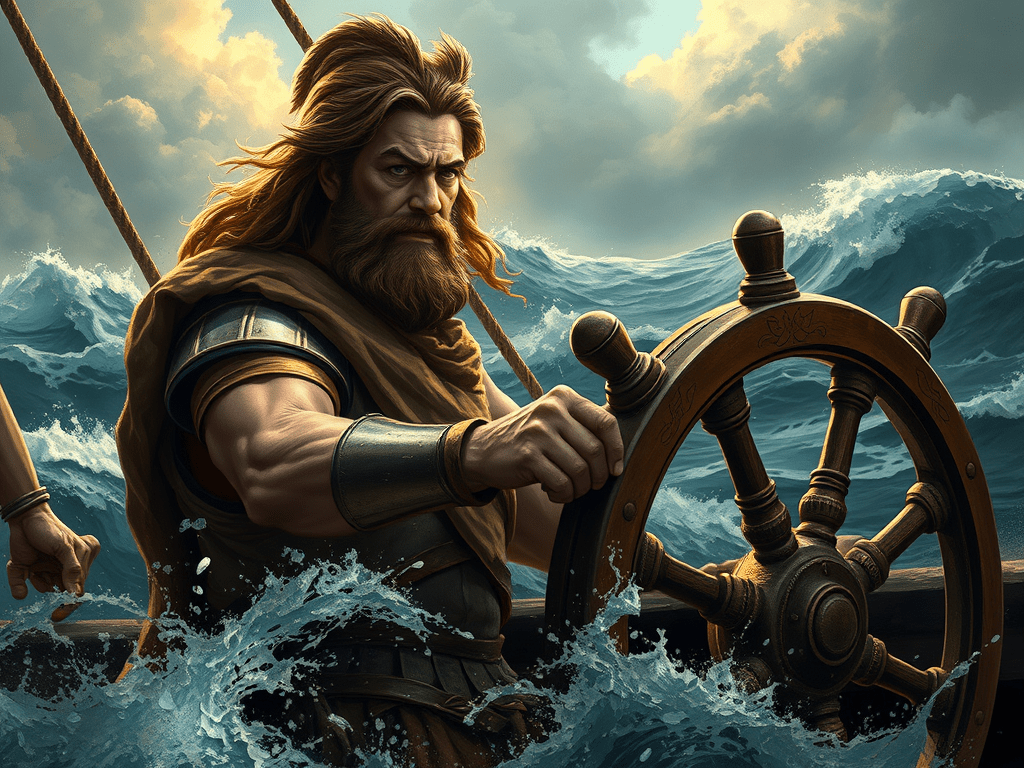
The previous discussion focused on the Victorian period, and today, the poem Ulysses by Alfred, Lord Tennyson will be explored. Before delving directly into the poem, a brief introduction is provided for context, as the discussion is intended for BA-1 students, and an extensive analysis will not be necessary.
The story of Ulysses has two potential sources: one is Homer’s epic, and the other is Dante’s Divine Comedy. However, the more prominent source is Homer’s Odyssey. The Odyssey narrates the story of Odysseus, a Greek warrior who lived around 500 BCE (subject to confirmation). He is a legendary figure known for his strategic prowess in warfare. In Greek mythology/legends, two great warriors stand out—Achilles and Odysseus. Additionally, there was a third warrior, Hector, from Troy.
Hector, the famous Trojan warrior, has even inspired the name of a modern car model. The conflict between Troy and Greece, known as the Trojan War, was largely caused by Helen, reputed to be the most beautiful woman on Earth. She was the wife of King Agamemnon. However, Paris, the youngest son of King Priam of Troy, fell in love with Helen and eloped with her. This act triggered the war between Greece and Troy.
During the Trojan War, Achilles and Odysseus fought on Agamemnon’s side and invaded Troy. Hector, as the elder or younger son of Priam, was eventually killed in a one-on-one battle against Achilles. Odysseus survived the war, and after its conclusion, he embarked on his journey back home.
While returning, Odysseus traveled by the Mediterranean Sea, as Troy and Greece were separated by this body of water. However, he faced challenges due to a curse. The curse stemmed from an incident during the conquest of Troy—Odysseus had destroyed a statue of the god Apollo. Apollo was revered as the god of war, rationality, and order and was worshipped by the Trojans. Additionally, Apollo was a close ally of Neptune, the god of the sea.
In Greek mythology, Neptune is the god of the sea. When Odysseus destroyed Apollo’s statue during the conquest of Troy, he was cursed. This curse was enforced by Apollo and carried out by Neptune. As Odysseus embarked on his journey home, he had to travel across the sea, giving Neptune the perfect opportunity to act against him. However, Odysseus received a favor as well—his mother Anticlea was closely associated with the goddess of wind.
Odysseus was given a bag containing powerful winds, tightly sealed to guide his ship directly toward Ithaca, his homeland. However, there was a strict condition: no one was to open the bag. He safeguarded it carefully, knowing that Neptune sought revenge and that the bag was his only tool to counteract the forces of the sea.
Despite his precautions, one of his crew members grew curious about the secret he was hiding. Believing the bag contained valuable treasures, this mariner opened it, leading to a fierce dispute on the ship. Unfortunately, as soon as the bag was unsealed, all the wind was released at once. As a result, Odysseus was doomed to wander aimlessly across the Mediterranean for ten years instead of returning home in a matter of weeks.
During this decade of wandering, Odysseus traveled through various lands, encountering different cultures and tribes, many located on islands or coastal regions of the Mediterranean. Over time, he grew older, his beard lengthened, and he became unrecognizable.
When he finally reached Ithaca, neither his wife, Penelope, nor his son, Telemachus, recognized him. Penelope and Telemachus had been waiting for ten years, but in the absence of the king, Ithaca had become vulnerable. Neighboring rulers sought to seize control of the kingdom. The only way for them to do so was by marrying Queen Penelope, as tradition dictated that the queen must be respected and her marriage would determine the ruler.
Many neighboring kings repeatedly proposed marriage to Penelope, but she continually refused. To delay the process, she devised a clever strategy—she began weaving a tapestry and claimed she would choose a suitor once it was completed. However, she unraveled her work each night, ensuring it was never finished. Through this ruse, she stalled for ten years.
During Odysseus’ absence, the moral fabric of Ithacan society deteriorated. Corruption and immorality spread in the absence of a ruling king. Telemachus, though the rightful heir, was still too young to claim the throne. Until he reached adulthood, he could not ascend to power or wage war against the rival kings threatening Ithaca’s sovereignty.
To prove his eligibility as a ruler, Odysseus must demonstrate his worthiness upon his return. This summary provides only the essential aspects of his story, rather than the complete narrative. The ten years of wandering serve as the background for the themes explored in Ulysses, the poem by Tennyson.
Because Odysseus traveled for so many years, the experience became a part of his identity. He no longer finds comfort in staying in one place. After returning to his kingdom, Ithaca, he undergoes a test to prove he is the real Odysseus, which he successfully passes. Following his acceptance, there is no further mention in Homer’s Odyssey of him engaging in future wars. However, in Dante’s Divine Comedy, there is a reference to Odysseus traveling through the Mediterranean and eventually reaching Hell. This moment in Divine Comedy serves as another important literary reference to his journey.
In Ulysses, Tennyson modernizes the character of Odysseus, which is why the name is changed from Odysseus to Ulysses. While both names refer to the same character, Tennyson’s interpretation aligns with a more contemporary outlook. The Victorian period was marked by rapid change—scientific advancements, the Industrial Revolution, and a redefinition of society. Rationality was evolving, and scientific progress was uncovering the mysteries of life. In this context, the traditional Odysseus from Homer’s Odyssey would not be entirely relevant. Instead, Tennyson reimagines him as a new kind of hero suited for the modern era.
In this poem, Ulysses is an old man who has already returned to Ithaca after wandering the Mediterranean for ten years. He has witnessed many cultures and experiences, remembering them all. However, unlike a weary traveler seeking rest, Ulysses maintains a different outlook on life. He is not disheartened by his past struggles; rather, he longs for more adventures. He desires to continue exploring, pursuing knowledge, and living life to its fullest. Although he has grown old, he does not feel bound by age—his spirit remains youthful.
This perspective aligns with the changes occurring in the Victorian age. Society was becoming more competitive, the free-market system was emerging, and the middle class was rising. Survival depended on understanding this new system. As a result, the traditional image of a king, as seen in Homer’s Odyssey, no longer applies. Ulysses does not wish to remain king; instead, he believes it is pointless to stay behind, stagnating in a land that no longer inspires him.
When he calls his land “barren,” he does not mean it in the literal sense. Rather, he is referring to the unproductivity of the people due to sloth, laziness, and corruption. Unlike them, he wants to move forward and witness the world’s transformation. More than that, he wishes to be an active participant in that change.
Ulysses wants to become a changemaker, which is why he calls upon his followers to join him on a new journey. However, there is a significant paradox—when Odysseus left Troy after its defeat, he was accompanied by his crew, but upon reaching Ithaca ten years later, he arrived alone. None of his original crew members survived; all perished during the journey.
Despite this, after some time, Ulysses again calls upon his crew. This implies that he had fought numerous battles alongside different warriors, some of whom may have survived and returned home safely. Although they had not accompanied Odysseus during his wandering years, they were still veterans of war. Now, he urges them to embark on a new journey—not one of conquest, but of intellectual exploration. This time, his quest is to seek knowledge “beyond the utmost bound of human thought.”
Traditionally, a king’s primary duty is to expand his empire by conquering neighboring kingdoms. However, Ulysses has a different perspective on life. He does not seek territorial expansion but instead pursues intellectual enlightenment. His goal is to “follow knowledge like a sinking star.” The reference to a sinking star (or a falling star) reflects an unpredictable and infinite pursuit—just as a star seems to fall in the sky yet remains far beyond reach, so too is knowledge boundless and ever-expanding.
This idea aligns with the intellectual movements of the Enlightenment and empiricism, which sought to redefine human understanding of the world. Scientific discoveries during this period revealed surprising and previously unknown facts about existence. People realized that their knowledge was limited, while the universe itself was limitless. There was no fixed boundary where human understanding ended—it continually expanded beyond prior limitations.
For instance, earlier biblical interpretations suggested that the Earth was only 5,000 to 7,000 years old. However, scientific research—such as the work of Charles Lyell, who studied geological layers—demonstrated that Earth was actually millions or even billions of years old. Those who accepted this new knowledge understood that there was no finite limit to discovery; knowledge stretched beyond human capacity.
Thus, Ulysses’ declaration to “follow knowledge like a sinking star beyond the utmost bound of human thought” reflects his desire to push past the perceived limits of human understanding. He does not wish to remain confined to what has already been discovered. Instead, he seeks the unknown.
The imagery of the sea plays a crucial role in this philosophy. The sea is vast, unpredictable, and turbulent—symbolizing the uncharted world of knowledge and adventure. It seems to call upon Ulysses, inviting him to embark on another journey, one that defies limitations and embraces the infinite possibilities of discovery.
In Ulysses, the sea symbolizes knowledge—vast, mysterious, and challenging to navigate, yet full of possibilities. It represents optimism and opportunity, but also the inherent risks and difficulties of exploration. This dual nature of the sea reflects what is often referred to as the “Victorian compromise”—a balance between hope and challenge.
The sea offers the chance to discover new worlds, cultures, societies, and forms of knowledge. However, it is also perilous. Ulysses acknowledges both possibilities: they may reach the “Happy Isles” or be “washed down by the sea.” In Greek mythology, the “Happy Isles” (or the Isles of the Blessed) represent a wish-fulfilling paradise where the greatest heroes are granted eternal peace. Reaching such a place would be an ultimate reward. However, Ulysses also recognizes the possibility of failure—being drowned by the very sea that promises adventure. This reflects the Victorian perspective, where progress and exploration were highly valued but carried significant risks.
Unlike in Homer’s Odyssey, where Odysseus eventually settles into his kingdom, Tennyson’s Ulysses is a different man—he embodies the spirit of the Victorian age. Victorians were driven by an insatiable curiosity and a relentless pursuit of knowledge. They sought to study subjects that had previously been restricted or deemed inappropriate.
A notable example of Victorian intellectual enthusiasm is captured in the phrase “a skeleton in the cupboard.” This phrase, which originated during the period, reflects society’s growing interest in uncovering hidden truths and exploring forbidden territories of knowledge.
During the Renaissance, the study of human anatomy was a central focus in fine arts. Artists glorified the human body, particularly the male form, as the pinnacle of beauty and strength. However, by the late 18th and mid-19th centuries, scientific inquiry shifted toward human physiology—the study of the inner workings of the body. Scientists moved beyond external anatomy and began exploring genetics, blood circulation, and the functions of internal organs.
Notable scientists, such as Gregor Mendel, made groundbreaking discoveries in genetics, while others studied blood sequencing and circulation. However, these advancements required extensive research on the human body, which posed an ethical challenge. Since no living person would consent to a postmortem examination, scientists had to find alternative means to conduct their studies.
This era of discovery, driven by Victorian curiosity, parallels Ulysses’ desire to explore the unknown. Just as scientists sought to uncover hidden aspects of human existence, Ulysses yearns to push beyond the limits of human understanding, embracing both the excitement and the peril that come with intellectual and physical exploration.
To further their studies in human physiology, scientists in the Victorian period resorted to extreme measures, such as exhuming fresh corpses from cemeteries. In religious traditions, the deceased were given proper last rites and buried within churchyards. However, at night, freshly buried bodies were secretly dug up, dissected, and studied for scientific research.
As people began to realize that corpses were being stolen, the authorities—police, known as “sheriffs” at the time—launched investigations. When the police arrived at the scientists’ workplaces, these physiologists would hurriedly hide the bodies in cupboards. In some cases, the police would search the cupboards and uncover the stolen corpses, giving rise to the phrase “a skeleton in the cupboard.” This expression became a metaphor for Victorian intellectual curiosity—people sought knowledge even in areas considered forbidden or restricted by religious and social norms.
This connects to Ulysses’ relentless pursuit of knowledge. His desire to “follow knowledge like a sinking star beyond the utmost bound of human thought” symbolizes his unstoppable quest for discovery. His character reflects the Victorian era’s expansionist mindset. During the colonial period, the British Empire spanned the entire globe, leading to the famous phrase that “the sun never sets on the British Empire.” This did not mean people never slept, but rather that the empire was constantly active, with different parts of the world operating at all hours.
This period was characterized by exploration, scientific advancements, and industrialization, redefining the nature of work beyond traditional boundaries of time and space. This same Victorian zeal for knowledge is embodied in Ulysses, who refuses to rest or stop. In the poem, he believes that “to pause is to end,” meaning stagnation is akin to death.
Ulysses compares himself to iron tools that rust if left unused. Similarly, if he does not continue his intellectual and physical pursuits, he fears that the knowledge he has gained will decay. This metaphor reinforces the idea that knowledge must be continuously sought and applied; otherwise, it becomes obsolete.
Despite his unwavering ambition, Ulysses makes a significant decision—he entrusts his kingdom to his son, Telemachus, before setting off on another journey. However, this raises a moral dilemma. While his determination is inspiring, it also reflects irresponsibility and selfishness. Instead of dedicating his later years to governing Ithaca and fulfilling his duties as king, he prioritizes his personal pursuit of exploration. His son, who has already grown up without a father for ten years, is left with the burden of rule, despite not being as capable as Ulysses himself.
This presents a paradox in Ulysses’ character. On one hand, his boundless enthusiasm and unyielding spirit are admirable. On the other hand, his actions could be seen as neglectful, as he abandons his responsibilities. His character embodies both the strengths and flaws of Victorian ambition—pushing beyond limits but sometimes at the cost of duty and responsibility.
The poem concludes with a powerful and inspiring line:
“To strive, to seek, to find, and not to yield.”
Even though Ulysses acknowledges his old age and physical weakness, his willpower remains unshaken. He is determined to continue striving, facing challenges, and exploring the unknown. He refuses to surrender to time, embracing a relentless pursuit of knowledge and adventure.


 Literary Latitude